
Bournemouth, England · opened 1910
Capacity 11,307. Who plays here, the matches it is known for, and how to get there.
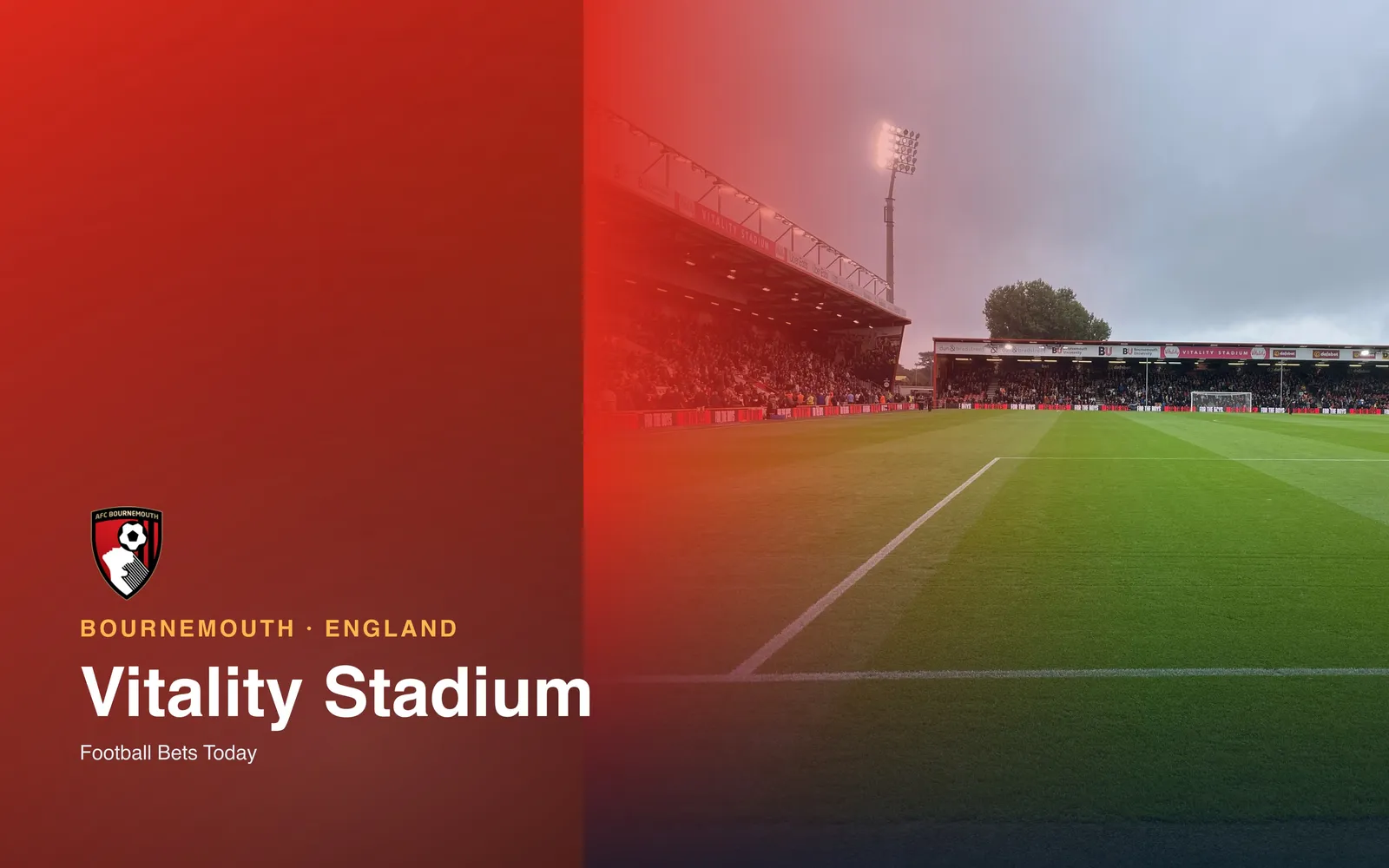
The ground
Facts
| Capacity | 11,307 |
|---|---|
| Opened | 1910 · renovated Rebuilt in stages 2001 and 2013–15 |
| Official name | Vitality Stadium (sponsor name since 2019; historically Dean Court) |
| Surface | grass |
| Owner | AFC Bournemouth |
| Record attendance | 28,799 · Bournemouth v Manchester United, FA Cup sixth round (1957) |
| Getting there | Bournemouth station is about 1.5 miles away, with buses and a walk through Kings Park. Main roads are the A338 and A35. |
History
Matches it is known for
- 1957 FA Cup sixth round v Manchester United
- 2015 promotion to the Premier League clinched
- First Premier League home match in 2015
In depth
About Vitality Stadium
Key takeaways
- Vitality Stadium and Dean Court are the same football ground in Bournemouth, England.
- Published capacity figures range from about 11,300 to 12,400 across different years and configurations.
- AFC Bournemouth have played at Dean Court since December 1910.
- The 2001 rebuild rotated the pitch through 90 degrees.
- The record attendance was 28,799 against Manchester United in the FA Cup on 2 March 1957.
Vitality Stadium is Dean Court, the football ground in Bournemouth, England: Dean Court is its historic name, while Vitality is the sponsorship name adopted in July 2015. AFC Bournemouth have played there since December 1910, and published capacity figures across different years range from about 11,300 to 12,400. For football and soccer followers across Africa, the attraction is the closeness of the stands to the action, a different scale from the large national stadiums familiar to many readers.
A Bournemouth home match can bring the same argument from a viewing centre in Accra or Abidjan into a much smaller space: how much can a crowd influence a game? Ghanaian supporters who followed Antoine Semenyo and Ivorian supporters who followed Max Gradel at this ground saw that question played out in a compact setting where individual reactions carry. Understanding its changing names, rebuilt stands and proposed expansion also helps explain why photographs, old match reports and capacity listings can appear to describe different venues.
What Is the Capacity of Vitality Stadium?
Vitality Stadium has a published capacity range of approximately 11,300 to 12,400, depending on the year and configuration being described. Historical listings include 11,464 in 2014 and about 11,300 in 2023, while another published figure is 12,357. Those figures should travel with their context. A stadium capacity describes an arrangement of seating and available accommodation, rather than an unchanging feature like the ground’s location.
The distinction matters when comparing an older stadium guide with a later listing. Stand additions, seating arrangements and the number of places available for a particular event can produce different totals. The published figures span roughly 1,100 places between the lower and upper ends of the range. For a visitor, the relevant figure is the capacity approved for the event being attended, rather than whichever total appears first in a search.
Who Plays at Vitality Stadium?
AFC Bournemouth have made Dean Court their home since December 1910. Its football identity belongs principally to the club, although international teams have used it too. England women played there in 2013, and England youth football includes under 21 matches held in 2017, 2019, 2022 and 2024.
The venue has also accommodated boxing, which helps explain why an event crowd need not match its football capacity. On 27 May 2023, Chris Billam-Smith beat Lawrence Okolie there to win the WBO cruiserweight title. About 15,000 attended, the largest non-football crowd in the stadium’s history. That evening belongs to the ground’s wider history, alongside the league fixtures and cup ties that give it its usual rhythm.
Why Are Dean Court, Seward Stadium and Goldsands the Same Ground?
Dean Court, Seward Stadium and Goldsands Stadium are names used for the same Bournemouth ground at different points in its history. The ground opened in 1910 on land given by the Cooper-Dean family, who gave the land. Sponsorship subsequently changed the name on signs and match listings. The familiar Dean Court name continued to connect those successive identities, which is why it remains useful when reading older football reports.
The sponsorship sequence began with Fitness First Stadium at the 2001 reopening, followed by Seward Stadium in July 2011 and Goldsands Stadium in 2012. Vitality Stadium followed in July 2015. The timeline below separates those changes clearly. A reference to a match at Goldsands does not mean Bournemouth moved elsewhere, just as a report using Dean Court can describe the ground during a period when a sponsorship name was in use.
| Name | Adopted |
|---|---|
| Dean Court | 1910 |
| Fitness First Stadium | 2001 |
| Seward Stadium | July 2011 |
| Goldsands Stadium | 2012 |
| Vitality Stadium | July 2015 |
How Do You Plan a First Visit to Vitality Stadium?
Plan your journey to Bournemouth, then check the final approach to the ground before travelling. The best station and onward connection depend on your service and walking requirements. Use public transport information for the actual travel date to compare rail, bus and walking options, especially for an evening fixture when the return journey needs equal attention.
Arrange your match ticket before committing to the journey, and read the entry instructions attached to it. A small stadium offers a close view, but its size does not establish that tickets will be easier to obtain. For a first visit from Lagos, Nairobi, Johannesburg, Accra or Kampala, leave room for unfamiliar connections and stadium entry. Check the fixture listing again before departure, because a changed kick off can affect the whole travel plan.
What Are the Pitch, Stands and Attendance Record?
Dean Court has a grass pitch listed at 105 by 68 metres. The stand named after former striker Ted MacDougall added 2,400 seats in 2013. The compact arrangement explains much of its character. Compared with many large African national venues, the spectator experience takes place within a much smaller enclosure.
The defining historical crowd came on 2 March 1957, when 28,799 watched Bournemouth face Manchester United in the FA Cup. That remains the ground’s record attendance, although it belongs to a different stadium layout and era of spectator accommodation. It cannot be read as the capacity of the rebuilt venue. When comparing football stadiums, keep record crowds separate from seated capacity, particularly where major rebuilding has changed the ground.
What Could Change With the Stadium Expansion?
A proposal announced in 2025 linked buying back the ground with expansion to approximately 20,000 seats, with potential for 23,000. The ownership background includes Bournemouth’s 2005 sale and leaseback arrangement. The proposed redevelopment would substantially increase the scale of the venue, but an announced target is different from completed seating. Existing capacity figures should therefore remain separate from the numbers attached to the expansion proposal.
What changes next, dated to the 2025 announcement: check the latest position on the purchase, detailed design, construction stages and seats available before arranging a visit. Those milestones determine what supporters can actually use. An estimated completion year is less useful for travel planning than confirmation of which stands are open for a particular fixture. The proposal also makes the date attached to any stadium photograph or seating plan especially important.
How Did the Rebuild Lead Into Bournemouth’s Premier League Story?
The 2001 rebuild transformed Dean Court by rotating the pitch through 90 degrees and creating a new arrangement around it. Bournemouth played their first eight home games during that work at the Avenue Stadium in Dorchester. The rebuilt ground reopened against Wrexham on 10 November 2001. That temporary move is an unusual part of the story: the club’s home identity endured while the physical setting underwent a substantial change.
Bournemouth’s Championship title in 2014 to 2015 meant the club reached the Premier League for the first time in 2014-15. Under Eddie Howe, that achievement completed three promotions in six years. For African viewers discovering Bournemouth through the EPL, the small stadium became part of the appeal. The useful comparison is between that intimate setting and the scale of the competition it hosted, with the club’s climb giving the ground a wider audience.
How Can Fans Across Africa Follow Bournemouth Home Matches?
Supporters in Nigeria, Kenya, South Africa, Ghana and Uganda can start with the fixture module, which carries kick off times in WAT, EAT, SAST and GMT together, allowing readers to plan for their own location. Check the date as well as the hour. English clock changes make a remembered time difference less useful than the local time attached to the actual match.
For viewers in Ghana and elsewhere in West Africa, use the relevant country listing to check which service carries the fixture and whether access is required. The same approach applies to a viewing centre in Nigeria or a home screen in Kenya, South Africa and Uganda. Two African connections give Bournemouth home matches extra interest: forward Antoine Semenyo, who played for the club and is followed in Ghana as a Ghana international, and winger Max Gradel, who played for Bournemouth and is followed in Ivory Coast as an Ivory Coast international. Before settling in to watch, confirm the local kick off and available coverage.
FAQ
What is the capacity of Vitality Stadium?
Published figures range from approximately 11,300 to 12,400 across different years and configurations. Examples include 11,464 in 2014 and about 11,300 in 2023; proposed expansion figures describe a future arrangement.
Who plays at Vitality Stadium?
AFC Bournemouth have played at the ground since December 1910. It has also hosted England youth and women’s football and boxing.
How do I get to Vitality Stadium?
Plan your journey to Bournemouth and check the onward approach to the ground. Compare rail arrivals and onward transport for your travel date, then check the return connection before booking.
Why is Vitality Stadium also called Dean Court?
Dean Court is the ground’s historic name from 1910, while Vitality Stadium is the sponsorship name adopted in July 2015. Fitness First Stadium, Seward Stadium and Goldsands Stadium were earlier sponsorship names for the same ground.
What is the record attendance at Dean Court?
The record attendance is 28,799, set on 2 March 1957 when Bournemouth played Manchester United in the FA Cup. It belongs to an earlier stadium layout and should not be read as the capacity of the rebuilt ground.
Written by Tunde Akinwande, 2026-11-11.