
Naples, Italy · opened 1959
Capacity 54,732. Who plays here, the matches it is known for, and how to get there.
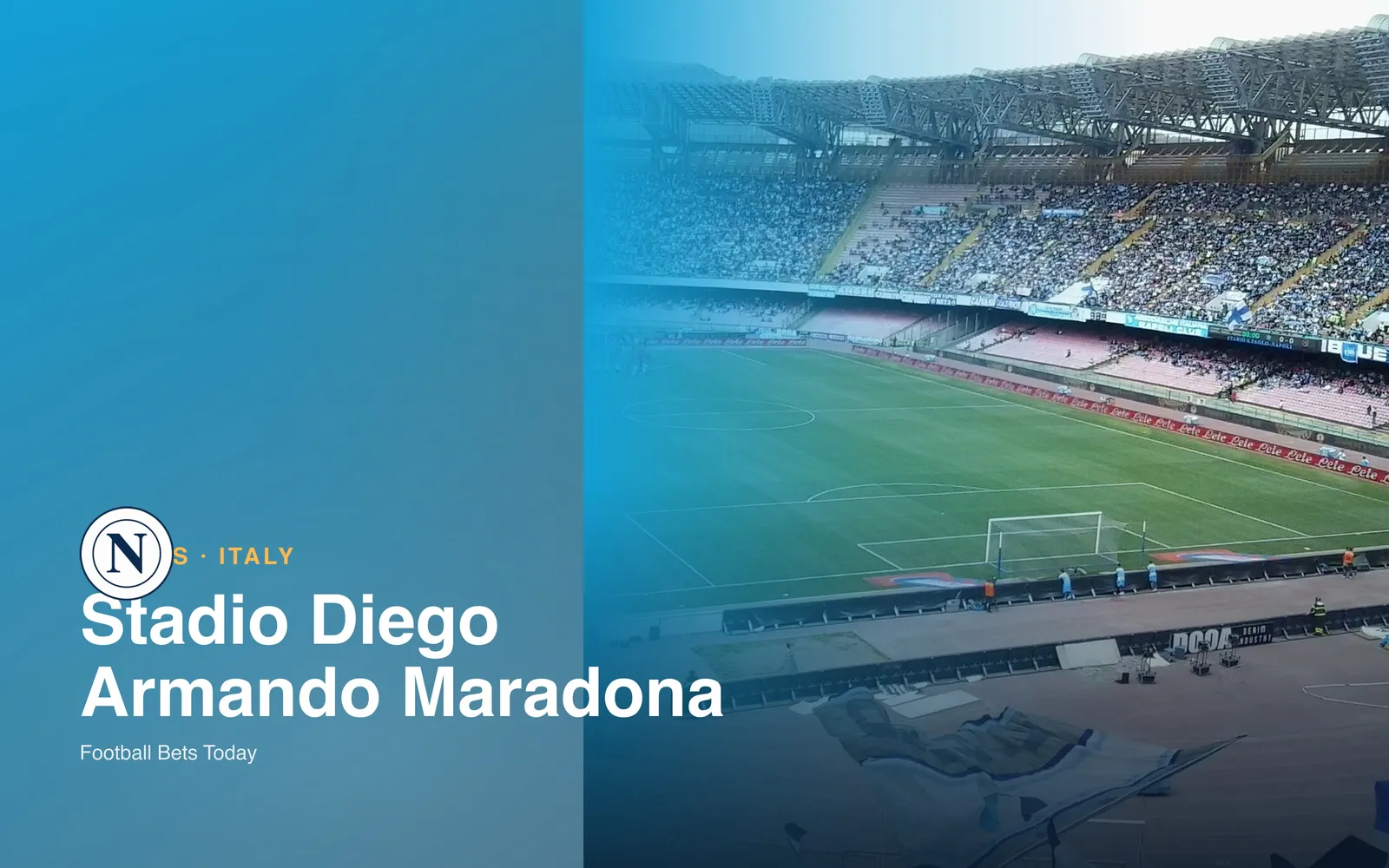
The ground
Facts
| Capacity | 54,732 |
|---|---|
| Opened | 1959 · renovated 1989–1990 for the 1990 World Cup; 2018–2019 for the Summer Universiade |
| Official name | Stadio Diego Armando Maradona (since December 2020; formerly Stadio San Paolo, 1963–2020, and Stadio del Sole at opening) |
| Surface | grass |
| Owner | Comune di Napoli (City of Naples) |
| Record attendance | 90,736 · Napoli v Juventus (1974) |
| Getting there | In the Fuorigrotta district of Naples, near Napoli Campi Flegrei station and the Cumana line. Tangenziale di Napoli is the main road access. |
History
Matches it is known for
- Football at the 1960 Summer Olympics (preliminaries)
- Mediterranean Games, 1963
- Four matches at Euro 1980
- Five matches at the 1990 World Cup, including the Italy v Argentina semi-final
- Opening ceremony of the Summer Universiade, 2019
In depth
About Stadio Diego Armando Maradona
Key takeaways
- Stadio Diego Armando Maradona is Napoli's home ground in Fuorigrotta, Naples, with a stated capacity of about 54,700.
- Stadio del Sole, Stadio San Paolo and Maradona Stadium are names for the same ground.
- The stadium was renamed on 4 December 2020, following Diego Maradona's death on 25 November 2020.
- Victor Osimhen's role in Napoli's 2023 championship gives Nigerian supporters a lasting connection to the stadium.
Stadio Diego Armando Maradona is Napoli's football stadium in Fuorigrotta, Naples, with a stated capacity of about 54,700. It hosts Napoli's home football, or soccer for South African readers, in Serie A and European competition, alongside occasional Italy internationals.
The ground has carried several names, so searches can return different results. It opened as Stadio del Sole in 1959 and became Stadio San Paolo in 1963. San Paolo remains familiar shorthand, while Maradona Stadium is the common English rendering of its name since December 2020. Nigerian supporters also recognise it through Victor Osimhen and Napoli's championship of 2023.
What Is the Capacity of Stadio Diego Armando Maradona?
The stadium has a stated capacity of about 54,700 spectators. Published figures differ slightly, between 54,732 and 54,726, so about 54,700 is the safest way to quote it. Available seats for an individual fixture can depend on its arrangements; use the seating information attached to that match when planning a visit.
Its record attendance belongs to a different stadium era: 90,736 watched Napoli against Juventus on 15 December 1974. That historical crowd is context, rather than a measure of how many supporters can enter today. The contrast helps explain the ground's reputation, because memories of packed terraces sit alongside the seated stadium that emerged through later renovations.
| Detail | Answer |
|---|---|
| Location | Fuorigrotta, Naples, Italy |
| Capacity | About 54,700 |
| Opened | 6 December 1959 |
| Renamed | 4 December 2020 |
| Tenants | Napoli; occasional Italy internationals |
| Pitch | Grass, 110 metres by 68 metres |
| Record attendance | 90,736, Napoli against Juventus, 15 December 1974 |
Who Plays at Napoli's Home Ground?
SSC Napoli have played here since the stadium opened in 1959, making league football its regular rhythm. European home matches add another setting, while the Italy national football team also uses the ground occasionally. Check the competition label in the fixtures module: a Napoli league game, European tie and international have different organisers and ticket arrangements, even when the destination is identical.
For Nigerian readers, Osimhen's contribution to Napoli's 2023 Serie A title is the strongest modern connection. That championship was the club's first since 1990, tying an African forward's achievement to the stadium's Maradona memory. Senegal defender Kalidou Koulibaly also played here during his Napoli years from 2014 to 2022. Those histories give African visitors familiar names without depending on who occupies the dressing room this season.
Why Was San Paolo Renamed After Maradona?
The name Stadio Diego Armando Maradona was approved on 4 December 2020, following Maradona's death on 25 November 2020. His Napoli connection rests on football achievement as much as affection: he helped the club win its first Serie A championship in 1987 and another in 1990. Naming the stadium after him placed that relationship on the building where so much of it unfolded.
The earlier names explain different chapters of the same address. Stadio del Sole identifies the ground at its opening in 1959, while Stadio San Paolo dates from 1963. A historical match report using San Paolo is therefore describing this stadium, and an English travel reference to Maradona Stadium usually means the same place. Compare it with other football stadiums through its city and tenants, rather than treating each name as a separate venue.
How Do You Get to Stadio Diego Armando Maradona?
The stadium is in Fuorigrotta, with Napoli Campi Flegrei and Mostra the useful station names to recognise. Campi Flegrei serves Metro Line 2 and rail connections; Mostra is on the Cumana railway. These are separate services, so choose the route from your starting point before setting off. Timetables, engineering work and special match services need a fresh check through local public transport information before travel.
From either station area, plan the final walk around the entrance printed on your ticket, following signs and steward directions. A taxi is another option, although an agreed meeting point away from the busiest approaches can help after the match. Allow time for the walk, queues and entrance checks. A station close to the stadium does not necessarily put you beside your allocated gate.
How Do Tickets and Stadium Sections Work?
Buy through the ticket route announced by the match organiser, checking the fixture, sector and admission instructions before payment. Napoli home tickets and Italy international tickets should be treated as separate purchases with their own conditions. Read any identification requirements and keep the ticket accessible on arrival. Seat availability, prices and sale dates belong to the individual event, so a past match is an unreliable guide to another booking.
Home support occupies the general home sectors, including the passionate Curve A and B, while visiting supporters have a designated away sector. Check the event's seating plan before choosing, particularly if you intend to support the visiting team. The curve are the stands behind the goals, associated with organised support and sustained singing. A side stand offers a different viewing angle; the best choice depends on your preferred matchday experience.
How Did the Stadium Develop From 1959?
The ground opened on 6 December 1959, when Napoli beat Juventus 2 to 1. Architects Carlo Cocchia and Luigi Corradi designed the stadium, which subsequently hosted Olympic football in 1960 and European Championship matches in 1968. Renovation for Euro 1980 brought another chapter, before the work of 1989 and 1990 prepared it for the World Cup. Its history is therefore broader than Napoli's domestic fixtures.
The stadium hosted five World Cup matches in 1990, then underwent another substantial renovation in 2018 and 2019 before the Summer Universiade. The renovation cost €20 million. Calling it a rebuild needs care: the work renewed an existing stadium rather than creating a completely new ground. The athletics setting remained part of its identity, alongside the football memories carried through successive changes.
Why Does Italy Against Argentina in 1990 Still Matter?
The defining international here is the 1990 World Cup semi final, when Maradona represented Argentina inside his own club's stadium. Italy and Argentina drew 1 to 1 after extra time, and Argentina advanced on penalties. The setting gave the match an unusual emotional weight: the player central to Napoli's achievements was facing the national side of the country where he played his club football.
That match helps explain why a stadium guide needs more than dimensions and transport directions. A ground can hold overlapping loyalties, and this one gave them a remarkable stage. For African readers following players abroad, the distinction is familiar: affection for a footballer and support for a national team can occupy the same conversation. Keep that particular evening attached to 1990, rather than assuming every supporter felt identically.
What Is Known About Redevelopment for Euro 2032?
Reports describe a developing redevelopment story: after the stadium was dropped as a Euro 2032 host, €50 million was allocated in September 2026 towards work intended to prepare it for the tournament. That is a dated account of funding and ambition. It does not establish that construction is complete or that tournament hosting has subsequently been confirmed.
For a visit, the useful questions are practical: which sections are open, whether entrances have changed and what transport arrangements apply to the event. A funding announcement cannot answer those questions. Treat final designs, construction dates, eventual capacity and tournament selection as matters requiring later confirmation, rather than reading them into the September 2026 allocation.
What Are the Layout and Matchday Atmosphere Like?
The ground has a grass pitch listed at 110 metres by 68 metres. The curve remain central to the stadium's sound, with Napoli's organised supporters contributing songs and flags that give home matches their recognisable character.
Maradona's presence also extends into Naples through murals and memorials, including the Spanish Quarter, which is a separate destination from Fuorigrotta. Plan those visits separately rather than expecting everything beside the stadium. For a Nigerian supporter, the journey can connect Maradona's championships with Osimhen's achievement in 2023, while leaving room to understand the city beyond the names already familiar from television.
How Can African Supporters Follow Matches From Naples?
Readers across Lagos, Nairobi, Johannesburg, Accra and Kampala can check the fixture's localised time next to its competition and viewing information. Rights differ by country and competition, so the viewing module for the relevant match is the place to confirm where it is shown. Lagos follows WAT, Accra follows GMT, Nairobi and Kampala share EAT, while Johannesburg keeps SAST. Because Italy changes its clocks seasonally, the gap from Naples shifts during the year.
For example, a winter kick off at 20:45 in Naples is 19:45 GMT, which is 20:45 in Lagos (WAT), 22:45 in Nairobi and Kampala (EAT) and 21:45 in Johannesburg (SAST). In summer the same Italian clock time is 18:45 GMT, so Lagos sees it at 19:45 (WAT), Nairobi and Kampala at 21:45 (EAT) and Johannesburg at 20:45 (SAST). These are conversion examples, not advertised fixtures. An evening start in Naples reaches Ghana in the early evening but arrives late at night in Kenya and Uganda, which shapes how supporters in each place plan their viewing. Nigerian supporters tend to follow Napoli through Osimhen's 2023 title. Before arranging your evening or travelling to the ground, confirm the match date, localised kick off and venue in the fixture listing.
FAQ
What is the capacity of Stadio Diego Armando Maradona?
The stated capacity is about 54,700. Published figures differ slightly between 54,732 and 54,726, so about 54,700 is the safest way to quote it.
Who plays at Stadio Diego Armando Maradona?
Napoli play their home matches at Stadio Diego Armando Maradona, having used the ground since 1959. Italy also stages selected international matches there.
How do I get to Stadio Diego Armando Maradona?
Head towards Fuorigrotta using Campi Flegrei for Metro Line 2 and rail services, or Mostra on the Cumana railway. Walk towards your allocated entrance from the station area, allowing time for matchday queues. Check current service information before leaving.
Why was Stadio San Paolo renamed after Maradona?
The stadium was renamed Stadio Diego Armando Maradona on 4 December 2020, following his death on 25 November 2020. He helped Napoli win Serie A in 1987 and 1990, so the name honours his place in the club's history.
What was the record attendance at the stadium?
The record is 90,736, set when Napoli played Juventus on 15 December 1974. That crowd belongs to an earlier stadium era and is not a measure of today's capacity.
Written by Tunde Akinwande, 2026-11-11.