
Lubumbashi, DR Congo · opened 2012
Capacity 18,000. Who plays here, the matches it is known for, and how to get there.
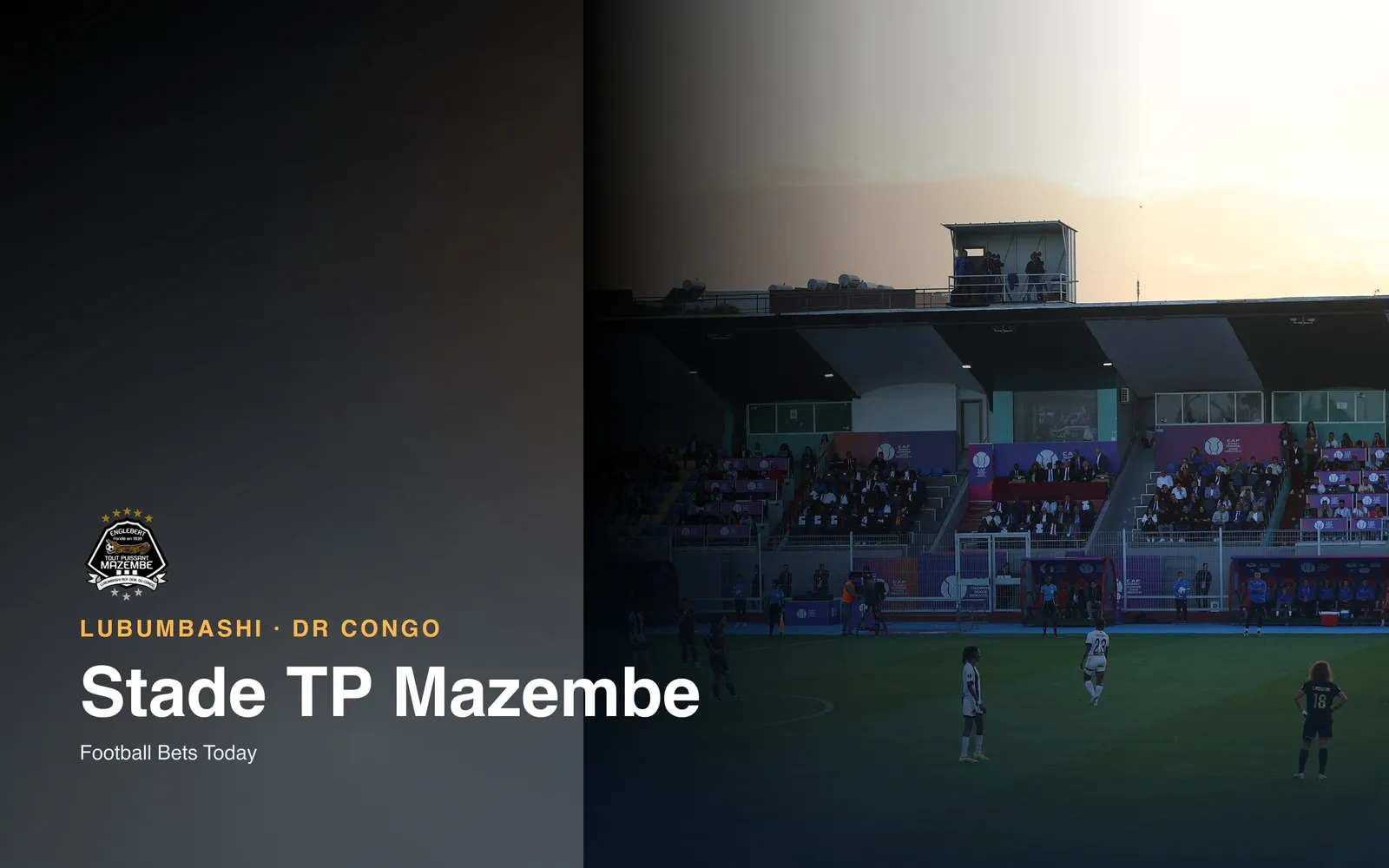
The ground
Facts
| Capacity | 18,000 |
|---|---|
| Opened | 2012 · renovated 2019 |
| Official name | Stade TP Mazembe (also called Stade Mwanke) |
| Surface | artificial |
| Owner | TP Mazembe |
| Getting there | On Avenue des Sports in the Kamalondo area of Lubumbashi, reached by road. |
History
Matches it is known for
- Opened 12 July 2012
- 2016 CAF Champions League: Mazembe 1–1 Wydad AC
- 2016 CAF Champions League first round: Mazembe 1–0 Saint George
- 2016 CAF Confederation Cup: Mazembe 3–1 Medeama
In depth
About Stade TP Mazembe
Key takeaways
- Stade TP Mazembe stands on Avenue des Sports in Kamalondo, Lubumbashi, DR Congo.
- Capacity listings checked in 2026 differ between 18,000 and 18,500, so about 18,000 to 18,500 is the careful answer.
- TP Mazembe own the stadium and have shared it with CS Don Bosco since 2012.
- The ground opened on 12 July 2012 and has an artificial grass pitch.
- Visitors should arrange road transport to Kamalondo and confirm admission arrangements for the specific fixture.
Stade TP Mazembe is a football stadium on Avenue des Sports in Kamalondo, Lubumbashi, DR Congo, with a listed capacity of about 18,000 to 18,500 as checked in 2026. Owned by TP Mazembe, it has housed both the Ravens and CS Don Bosco since 2012, making it a familiar destination for African football and soccer followers.
Stade Mwanke is another name for the ground, while Stade Tout Puissant Mazembe uses the club’s full name. Think of the names as different directions to the same address, something a Lagos visitor can appreciate before setting out. The stadium history and matchday guidance below help you distinguish the venue from the club and plan around the fixture information.
What Is the Capacity of Stade TP Mazembe?
Stade TP Mazembe holds about 18,000 to 18,500 spectators according to the differing capacity figures listed in 2026. The distinction deserves a plain explanation: some listings give 18,500 and others give 18,000. The two figures are both in circulation, so the range gives the fullest picture. Using the range is more useful than presenting either number as an exact count.
Capacity describes the ground’s listed size; it does not establish how many tickets will be available for a particular match. Check the admission announcement attached to your chosen fixture before making arrangements. No record attendance is listed, so a capacity figure should never be presented as proof of an attendance record.
| Detail | Answer |
|---|---|
| Location | Avenue des Sports, Kamalondo, Lubumbashi, DR Congo |
| Listed capacity in 2026 | About 18,000 to 18,500 |
| Opened | 12 July 2012 |
| Renovated | 2019 |
| Surface | Artificial grass |
| Owner | TP Mazembe |
| Tenants since 2012 | TP Mazembe and CS Don Bosco |
Who Plays at the Ground in Kamalondo?
TP Mazembe and CS Don Bosco have both used the stadium as their home since 2012, with Mazembe owning the ground. That shared tenancy matters when reading a fixture listing: the stadium name alone does not tell you which club is hosting. Check the home team and competition alongside the venue, especially when arranging a visit around a domestic match rather than a continental tie.
Why Is It Also Called Stade Mwanke?
Stade Mwanke is a former name associated with Stade TP Mazembe, while Stade Tout Puissant Mazembe expands the initials in the club’s name. These names refer to the same stadium in Kamalondo. Stade TP Mazembe is the clearest starting point when searching fixtures, and Avenue des Sports provides the useful address when discussing transport. No dated renaming sequence is listed, so the alternative names should not be mistaken for evidence of separate grounds.
When Did Stade TP Mazembe Open?
Stade TP Mazembe opened on 12 July 2012, following construction that began in April 2010, and underwent renovation in 2019. The ground has an artificial grass surface, a detail worth knowing when watching the pitch closely during a CAF tie. Those dates distinguish the stadium’s history from the much longer history of its owner: Mazembe were founded on 28 November 1939 as FC Saint-Georges by Benedictine monks from the Institut Saint-Boniface school, in the city then called Élisabethville.
The opening date also puts an important limit on the stories attached to the venue. Mazembe’s famous appearance in the 2010 Club World Cup final came before this stadium opened. Their continental reputation arrived with them in Kamalondo, but that earlier achievement belongs to the club’s story rather than to a match played inside this ground. When comparing African football stadiums, keeping that distinction makes the history easier to follow.
Why Does This Ground Matter Across African Football?
The stadium matters because its owner has a continental record that reaches well beyond Lubumbashi. Mazembe won the African Champions’ Cup in 1967 and 1968, then the CAF Champions League in 2009, 2010 and 2015. Those five titles explain why the Ravens, known as Les Corbeaux and also as Les Badiangwena (The Crocodile Eaters), command attention when a CAF draw sends another African club to Kamalondo. A stadium’s significance is not measured by capacity alone.
Mazembe became the first African club to reach the Club World Cup final in 2010, losing 3-0 to Inter Milan. That achievement gave supporters across Africa a reference point for what a continental champion could accomplish. For readers in South Africa, Nigeria and East Africa, it also explains the weight attached to a Lubumbashi away fixture. The challenge comes with the opponent’s pedigree; the ground itself should never be treated as deciding a result.
How Do You Get to Stade TP Mazembe?
For an air arrival, the general route is through Lubumbashi’s airport and then by road to Avenue des Sports in Kamalondo. Give your transport provider both the stadium name and the neighbourhood, including Stade Mwanke if that helps establish the destination. Journey times vary, so confirm locally rather than assuming a fixed airport journey time, distance or public transport connection.
Confirm your outward and return arrangements locally before leaving for the match, allowing flexibility around the advertised kick off. Ask your accommodation or transport provider to confirm a suitable drop off and collection point for that fixture. If you are comparing grounds before travelling, the wider guide to football stadiums provides another starting point, while the match announcement should settle the venue for your actual visit.
What Should Supporters Check Before Matchday?
Supporters should confirm the fixture, venue and ticket arrangements through the hosting club and the relevant competition’s announcements. For domestic football, follow the club’s information alongside the domestic league’s fixture notices; for a continental match, check the competition details too. Use those channels for practical arrangements rather than assuming an old ticket notice still applies. No permanent price, sales location or admission procedure should be carried over from another fixture.
The fixture module above supplies the changing match information, while the ground’s artificial pitch and Kamalondo location provide the lasting context. Check that a listing names this stadium before travelling, then confirm the announced entrance and admission requirements. Capacity is the listed figure, so rely on the fixture’s own announcement for what applies on the day.
Which CAF Matches Help Explain Its Reputation?
Mazembe’s 3-1 victory over Medeama in the 2016 CAF Confederation Cup group stage gives Ghanaian readers a direct connection to this ground. It is a useful defining match because it places a familiar Ghanaian club inside the stadium’s continental story. Mazembe went on to win the Confederation Cup in 2016 and retained the trophy in 2017, adding another competition to their established Champions League history.
The stadium also hosted a 1-1 draw against Wydad AC in the 2016 CAF Champions League. Read those historical results with their competition labels attached, because Champions League and Confederation Cup matches belong to different campaigns. Readers in Kenya and Uganda, who sit closest to DR Congo, and Ghanaian readers recalling the Medeama tie, will want to know Trésor Mputu, the club’s top scorer with 206 goals across competitions. The same habit applies to him: establish the competition and confirmed team sheet before connecting him to a particular Kamalondo occasion.
How Can Fans Across the Five Countries Follow Matches?
Coverage depends on the competition and territory, so readers in Nigeria, Kenya, South Africa, Ghana and Uganda should look at the broadcaster named against each fixture. A domestic fixture and a CAF tie need separate checks. Read kick off times together in WAT for Nigeria, EAT for Kenya and Uganda, SAST for South Africa, and GMT for Ghana, then confirm which time zone your device displays.
The fixtures and results modules answer changing questions about dates and scores; the stadium guide explains where those matches take place. If a listing includes a broadcaster or streaming service, confirm that the coverage applies in your country before arranging your viewing. Before travelling or settling down to watch, match the named venue, local kick off time and access details to the specific fixture.
FAQ
What is the capacity of Stade TP Mazembe?
Stade TP Mazembe has a listed capacity of about 18,000 to 18,500, checked in 2026. The range reflects differing figures in listings in 2026 rather than separate seating arrangements.
Who plays at Stade TP Mazembe?
TP Mazembe and CS Don Bosco have both used the ground as their home since 2012. TP Mazembe own the stadium.
How do I get to Stade TP Mazembe?
Travel by road to Avenue des Sports in Kamalondo, Lubumbashi; visitors arriving by air can arrange onward transport from Lubumbashi’s airport. Journey times vary, so confirm the route and return collection locally.
Why is Stade TP Mazembe also called Stade Mwanke?
Stade Mwanke is a former name for the same ground in Kamalondo, while Stade Tout Puissant Mazembe expands the club’s initials. They all point to one stadium.
When did Stade TP Mazembe open?
The stadium opened on 12 July 2012, after construction began in April 2010, and it was renovated in 2019. It has an artificial grass pitch.
Written by Tunde Akinwande, 2026-11-11.