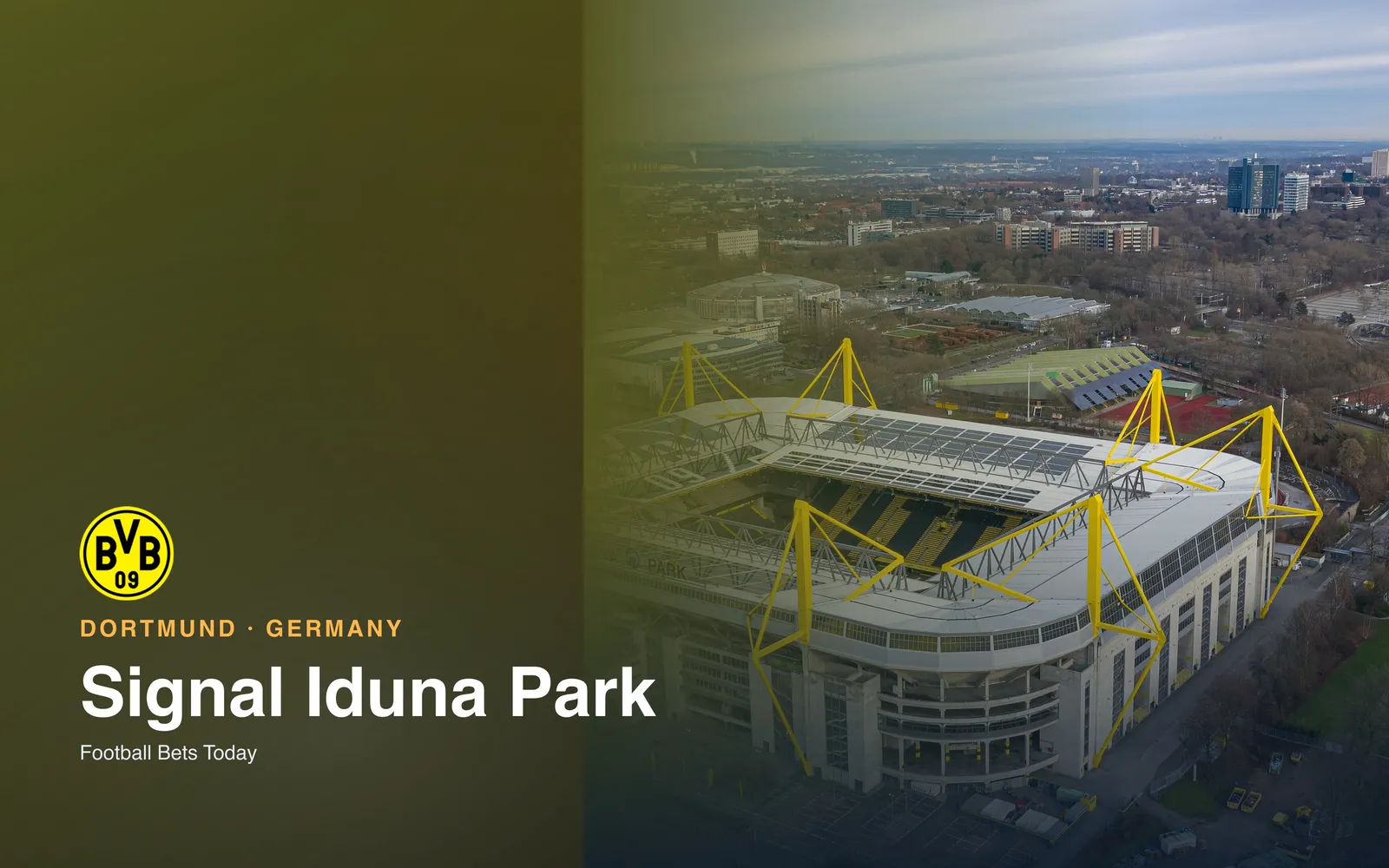
Dortmund, Germany · opened 1974
Capacity 81,365. Who plays here, the matches it is known for, and how to get there.
The ground
Facts
| Capacity | 81,365 |
|---|---|
| Opened | 1974 · renovated 2002–2006, for the 2006 World Cup |
| Official name | Signal Iduna Park (since 2005; formerly Westfalenstadion) |
| Surface | hybrid |
| Owner | Borussia Dortmund (stadium owned by Stadion Dortmund GmbH, club-controlled) |
| Getting there | Dortmund Stadion station (U42) and Westfalenhallen are nearby, with U-Bahn from the main station. The B1 passes the ground. |
History
Matches it is known for
- 1974 World Cup matches
- 2001 UEFA Cup final: Liverpool 5–4 Alavés
- 2006 World Cup semi-final: Germany 0–2 Italy
- Euro 2024 semi-final: Netherlands 1–2 England
- Home of the Südtribüne (Yellow Wall)
In depth
About Signal Iduna Park
Key takeaways
- Signal Iduna Park is Borussia Dortmund’s home in Dortmund, Germany, also known as the Westfalenstadion.
- The 2026 reference capacity is 81,365 for Bundesliga matches, compared with about 66,000 in an all seated configuration.
- The Yellow Wall is the south stand, accommodating roughly 25,000 standing supporters.
- Zaire, Togo and Ghana played World Cup matches at Dortmund in 1974 and 2006.
Signal Iduna Park is Borussia Dortmund’s home ground in Dortmund, Germany, with a Bundesliga capacity listed at 81,365 in 2026. Also known as the Westfalenstadion, BVB Stadion Dortmund and simply Dortmund Stadium, it is a football ground familiar to soccer followers across Africa.
Westfalenstadion is the original name, Signal Iduna Park is the commercial name used since 2005, and BVB Stadion Dortmund is the name used for UEFA tournaments, so all three describe the same ground. The attraction is easier to understand: a vast south stand, major international matches and an African connection stretching from Zaire in 1974 to Ghana in 2006. Start with the capacity and transport arrangements, then choose the match and viewing area that suit your visit.
What Is the Capacity of Signal Iduna Park?
The 2026 reference capacity is 81,365 for Bundesliga matches, combining seated areas with standing terraces. An all seated international configuration accommodates about 66,000, with published figures differing slightly according to the event arrangement. Installing seats in terrace areas reduces the number of people those sections can accommodate. The seating plan for each fixture sets the capacity, so the competition name alone does not establish it for a particular match.
The stadium opened with room for 53,872 in 1974, while seating changes brought capacity down to 42,800 in 1992. Later expansion produced the much larger ground familiar today. Its historical record crowd is listed as 83,000, including the Dortmund against Schalke match on 30 January 2004. That older attendance belongs to an earlier configuration; visitors should use the allocation and seating plan attached to their chosen match.
Who Plays at Dortmund Stadium?
Borussia Dortmund play their home club fixtures here, while Germany have also used the stadium for international football. Dortmund’s domestic programme brings Bundesliga opponents and cup ties, with European matches depending on qualification. The fixture module identifies the competition and confirmed date. Read those details together before arranging travel, because a league fixture and an international tournament can have different seating plans, entrance arrangements and ticket conditions.
Two fixture names help newcomers understand the crowd: Der Klassiker means Dortmund against Bayern Munich, while the Revierderby means Dortmund against Schalke. The latter carries the geography of neighbouring Ruhr cities into the stands. For readers comparing football stadiums, Dortmund’s distinction is how much of the matchday identity centres on standing support. The south stand gives that identity a visible home, even when the opponent changes.
What Makes the Yellow Wall Famous?
The Yellow Wall, or Die Gelbe Wand, is the Südtribüne at the southern end, holding roughly 25,000 standing supporters in its terrace configuration. Its scale makes a familiar football ritual extraordinary: scarves rise across an enormous bank of people, songs travel together and large displays fill the stand. Television catches the colour, but the continuous concentration of supporters explains why this section has become so closely associated with Dortmund.
A standing ticket means spending the match on your feet among an active crowd, with your view affected by people immediately ahead. Overseas visitors who prefer a defined place or need to sit should consider a seated section elsewhere. Check the actual event configuration before choosing: a tournament ticket for the south end does not necessarily offer the same terrace experience as a Bundesliga match.
How Do You Get There From Dortmund Hbf?
Dortmund Hbf, the main railway station, is the most useful starting point for visitors arriving from another city. Use the journey planner for services towards the stadium area and check event services before departure, rather than assuming every route finishes beside the turnstiles.
Allow extra time for the walk, entrance checks and the return journey. Save the route to your accommodation before leaving, since crowds can make choosing a connection after the final whistle less straightforward.
Why Does the Stadium Have Different Names?
Westfalenstadion was the original name when the ground opened on 2 April 1974, and Signal Iduna Park became its commercial name on 1 December 2005. Westfalenstadion remains a familiar name among supporters. The naming history explains why an older match report, a modern fixture listing and a tournament ticket can describe the same address differently. Dortmund Stadium is simply another common way of identifying the venue.
Tournament naming arrangements explain the other labels: the ground was FIFA World Cup Stadium Dortmund during the 2006 World Cup, while BVB Stadion Dortmund is used for UEFA tournament purposes. Expansion also changed the building itself, with major work in 1992, between 1995 and 1999, and in 2002 to 2003 and again in 2006. Those changes turned the original World Cup venue into a much larger home for club football.
Which Major Matches Shaped Its History?
Dortmund hosted the World Cups of 1974 and 2006, the 2001 UEFA Cup final and matches at Euro 2024. Liverpool played Alavés in the 2001 UEFA Cup final on 16 May 2001. For international football, Italy beat Germany 2 to 0 in the semi final on 4 July 2006, which gives the ground another lasting reference point.
The Netherlands beat Brazil 2 to 0 here on 3 July 1974, while England beat the Netherlands 2 to 1 in the Euro 2024 semi final on 10 July 2024. Germany’s 2 to 0 victory over Denmark on 29 June 2024 was another tournament knockout match. These occasions explain why the stadium belongs in international football memory as well as Dortmund’s own story.
Where Does Africa Fit Into Dortmund’s Story?
Africa’s tournament connection begins with Zaire, now DR Congo, who faced Scotland here on 14 June 1974 before 25,000 spectators. Scotland won 2 to 0 in Zaire’s World Cup appearance. Togo then faced Switzerland here on 19 June 2006, and Switzerland won 2 to 0 in Togo’s first World Cup.
For Ghanaian readers, the defining match is Brazil’s 3 to 0 victory over Ghana on 27 June 2006. It was the Black Stars’ round of 16 match at their first World Cup, a stage they reached on debut. Dortmund’s club story adds African internationals including Gabon’s Pierre Emerick Aubameyang, who joined in 2013. Readers in Nigeria, Kenya and Uganda have no tournament match of their own at this ground, so their connection runs through the African internationals Dortmund sign: Aubameyang’s Gabon link drew pan African attention to the club, and the player module shows which African players Dortmund have in the squad for those who want to follow them.
| Date | Competition | Match | Attendance |
|---|---|---|---|
| 14 June 1974 | World Cup group stage | Scotland 2 to 0 Zaire | 25,000 |
| 19 June 2006 | World Cup group stage | Togo 0 to 2 Switzerland | Not stated |
| 27 June 2006 | World Cup round of 16 | Brazil 3 to 0 Ghana | Not stated |
How Can Fans Across Africa Watch or Visit?
Compare the kick-off time in the fixture module with the viewing information for your own country, since rights differ by competition and territory. For a 15:30 start in Germany, summer conversion is 14:30 WAT, 16:30 EAT, 15:30 SAST and 13:30 GMT; winter conversion is 15:30 WAT, 17:30 EAT, 16:30 SAST and 14:30 GMT. The fixture module’s local time should guide your viewing plans.
For attendance, check the organiser’s ticket arrangements and choose between seated accommodation and standing areas according to your needs. Read access information before booking if anyone in your group needs step free routes or accessible seating. A stadium tour can offer another way to visit when match admission is unavailable, subject to its schedule. Before committing to flights, confirm the fixture date and admission details.
FAQ
What is the capacity of Signal Iduna Park?
Its Bundesliga capacity is listed at 81,365 in the 2026 reference figures. An all seated international arrangement holds about 66,000 because seating reduces the capacity of terrace areas.
Who plays at Signal Iduna Park?
Borussia Dortmund play their home club matches at Signal Iduna Park. Germany have also played there, and the stadium hosted matches at the 1974 and 2006 World Cups and Euro 2024.
How do I get to Signal Iduna Park?
Travel towards the stadium area from Dortmund Hbf using the journey planner and the service shown for your event. Check the return timetable before setting off.
Why is Signal Iduna Park also called Westfalenstadion?
Westfalenstadion was the original name when the ground opened on 2 April 1974, and Signal Iduna Park became its commercial name on 1 December 2005. Supporters still use both names.
What is the Yellow Wall at Dortmund?
The Yellow Wall, or Die Gelbe Wand, is the Südtribüne at the southern end of the stadium. It holds roughly 25,000 standing supporters in its terrace configuration.
Which African teams have played at Dortmund?
Zaire played Scotland on 14 June 1974, Togo played Switzerland on 19 June 2006 and Ghana played Brazil in the round of 16 on 27 June 2006.
Written by Tunde Akinwande, 2026-11-11.