
Blantyre, Malawi · opened 1964
Capacity 65,000. Who plays here, the matches it is known for, and how to get there.
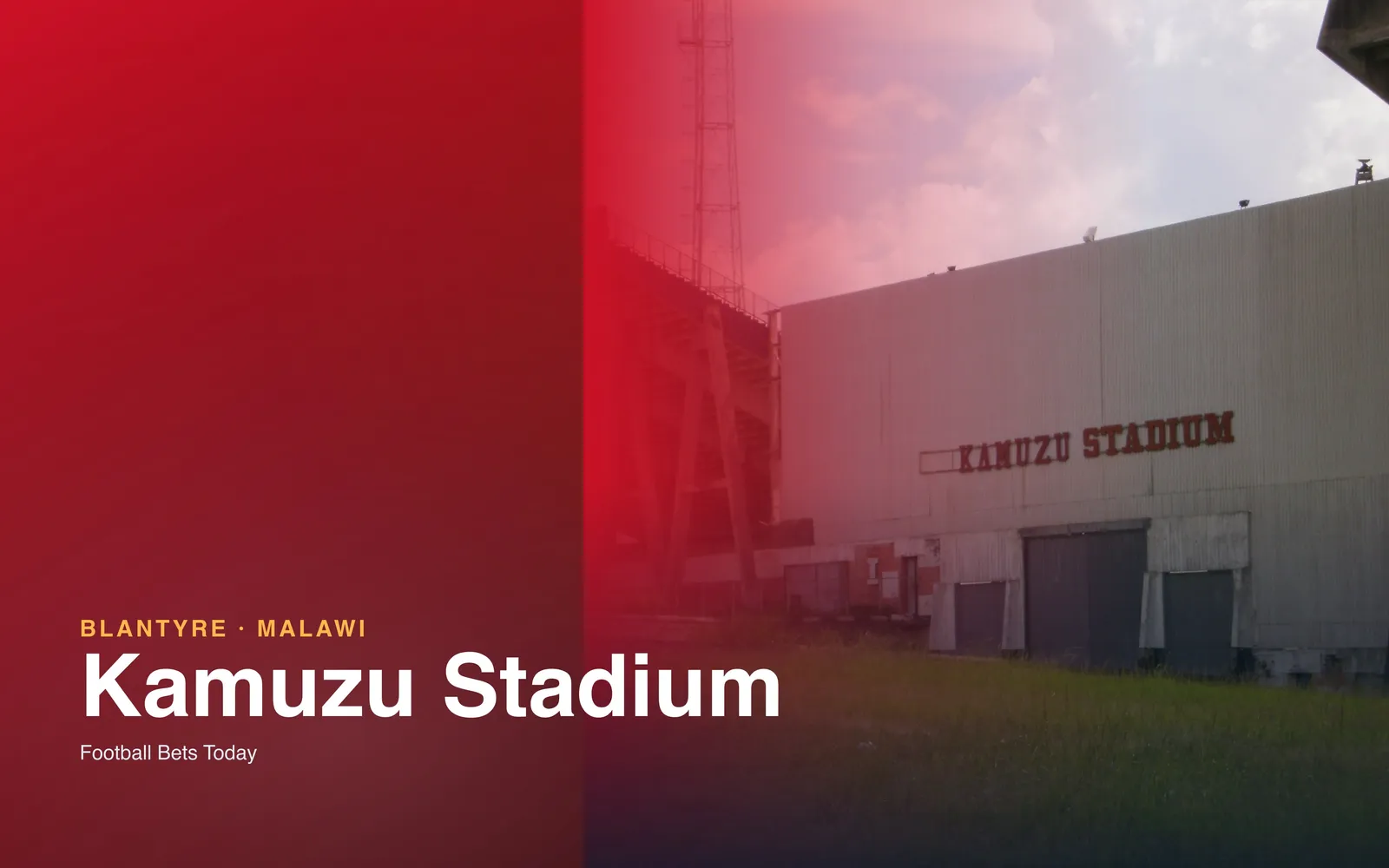
The ground
Facts
| Capacity | 65,000 |
|---|---|
| Opened | 1964 · renovated 1968 (main stands) and 2004 (including a FIFA GOAL-funded artificial turf pitch) |
| Official name | Kamuzu Stadium (name restored in 2004; no sponsor name) |
| Surface | artificial |
Tenants
Who plays here
- Nyasa Big Bullets
- Mighty Wanderers
- Malawi national football team (until 2017)
History
Matches it is known for
- 2 June 2014: Peter Mutharika's presidential inauguration
- 1964: opened as Rangeley Stadium
In depth
About Kamuzu Stadium
Key takeaways
- Kamuzu Stadium opened in Blantyre in 1964 and became a historic home of the Blantyre derby.
- FAM excluded the stadium from elite football in April 2026 pending a fresh structural assessment.
- Capacity is best read as dated limits, not one headline number: 22,000 before the reduction and 14,600 after it.
- A June 2018 report recorded a reduction from 22,000 to 14,600 following a September 2017 FIFA inspection.
- On 20 October 2026, FAM president Fleetwood Haiya was reported as saying the stadium would be demolished and replaced.
Kamuzu Stadium is a historic football stadium in Blantyre, Malawi, opened in 1964 and closely associated with the Blantyre derby. As reported in April 2026, FAM had excluded the ground from elite football pending a fresh structural assessment, so its familiar place in Southern African soccer comes with an essential venue check.
The capacity question needs the same care: safety restrictions produced limits of 22,000 and then 14,600, so no single listed figure should be treated as what the ground can hold on a matchday. In the fixture module, read the venue field as the ground actually named for that match, and do not assume a club's historic home is the stadium in use.
Can Kamuzu Stadium Host Elite Football?
The April 2026 FAM decision prevented Kamuzu Stadium from hosting elite football until a fresh structural assessment was completed. Reporting on 28 April linked that decision to concerns about the stands and the absence of a structural inspection since 2012. The scheduled Premiership opener between Mighty Wanderers and Karonga United was postponed. That is the practical starting point for anyone planning around the ground: an advertised pairing alone does not establish that Kamuzu is an approved venue.
The longer term proposal went further than another reopening. In reporting dated 20 October 2026, FAM president Fleetwood Haiya said Kamuzu Stadium would be demolished and replaced. That statement describes an announced direction, rather than confirmation that demolition or construction had finished. Read the dated closure history alongside the fixture module, where the named venue matters as much as the teams and kick-off.
What Is the Capacity of Kamuzu Stadium?
Kamuzu Stadium is not hosting elite matches under the April 2026 restriction; its last documented reduced limit in the supplied historical reporting was 14,600 in 2018. No listed figure should therefore be treated as a ticket allocation. Capacity depends on which parts of a stadium can safely open, how spectators enter and leave, and the conditions attached to approval. An old headline figure cannot settle those questions.
The clearest documented change followed FIFA's September 2017 safety and security inspection. The Nation reported on 4 June 2018 that capacity would fall from 22,000 to 14,600, provided the cordoned stands remained closed. Those figures describe restricted use rather than a fresh measurement of the stands. There is no verified record attendance in the available register, so neither a capacity listing nor memories of a crowded derby should be presented as an attendance record.
| Date or Record | Figure | Meaning |
|---|---|---|
| Before the reduction reported in June 2018 | 22,000 | Capacity before the reduction. |
| June 2018 report following September 2017 inspection | 14,600 | Reduced capacity conditional on cordoned stands remaining closed. |
| April 2026 FAM decision | No elite matches until a fresh structural assessment is done | An operational restriction, not a new measurement of the stands. |
Who Plays at Kamuzu Stadium?
The stadium's historic home teams include Nyasa Big Bullets and Mighty Wanderers, while Malawi's national team used it until 2017. Their Blantyre derby gives the ground its strongest domestic football association. The 2018 capacity report identified that fixture as particularly exposed to reduced gate receipts, showing how a safety decision also changes the number of supporters who can share a city's biggest football occasion.
Where do the clubs play after the April 2026 restriction? Their venue must be checked fixture by fixture among approved grounds, rather than assuming either club has simply transferred every home match to the same replacement. The postponed Wanderers against Karonga fixture is the defining example here: even an opening match needed its venue question resolved. Supporters should use the confirmed stadium field in the fixture module before buying tickets or arranging transport.
Why Has Kamuzu Stadium Had Different Names?
Rangeley Stadium, Chichiri Stadium and Kamuzu Stadium refer to the same Blantyre ground at different points in its history. It opened in 1964 as Rangeley Stadium, named after British civil servant William H. J. Rangeley. The later Kamuzu name honoured Hastings Kamuzu Banda, Malawi's first president. These names connect the venue to the country's political history, which explains why older accounts can describe familiar football surroundings under a different heading.
Under Bakili Muluzi, the ground became Chichiri Stadium. The Kamuzu name returned in 2004 under Bingu wa Mutharika. That sequence helps readers searching older match reports or asking relatives about the ground: the changing name does not indicate a move to another stadium. Kamuzu Stadium Blantyre is the useful geographical description when distinguishing this historic venue from grounds elsewhere in Malawi.
How Do I Get to Kamuzu Stadium?
Kamuzu Stadium is in Blantyre, but the April 2026 elite football restriction must come before any matchday directions. Give a driver the stadium name, then confirm the appropriate access point locally. Historical ground descriptions are useful for finding the site; they do not establish that a gate is open, that visitors can enter, or that a football match will take place there.
For a match involving either Blantyre club, start with the confirmed venue and ticket announcement before choosing your route. Buy through the arrangements announced for that particular fixture, and follow its entry instructions. A replacement ground can have different gates, seating and transport needs. The wider guide to football stadiums helps distinguish a club's historic home from the venue actually staging an advertised match.
What Replaces Kamuzu for Clubs and Malawi's National Team?
The October 2026 announcement proposed upgrading Mpira Stadium for international matches. The national team's departure from Kamuzu in 2017 is therefore an important dividing line in its history. A national team fixture associated with Malawi should not automatically send a travelling supporter towards Blantyre: the stadium named against that match determines the destination.
The proposals address different needs: replacing Kamuzu concerns Blantyre's historic ground, while upgrading Mpira would add international match capability. Neither announcement supplies a completed building or a confirmed opening date. For domestic supporters, the immediate answer remains the approved venue attached to each fixture. The April 2026 dispute also reached beyond the turnstiles, with news reporting that FDH Bank suspended its K7.5 billion sports sponsorship package after the dispute.
How Did the Pitch and Stands Change?
Kamuzu developed through major work in 1968 and 2004, with artificial turf replacing its natural grass pitch through FIFA's GOAL programme. The main stands were completed in 1968 to designs by L. Jeffery and Steve Price. These changes matter because the playing surface and spectator accommodation have separate histories. A renovated pitch can support football without answering the structural questions affecting the people watching from the stands.
Engineers raised concerns about cracked sections of the eastern stands in 2012, according to the April 2026 reporting. FIFA's September 2017 inspection addressed a wider set of requirements, including covered stands, toilets, drainage, dressing rooms and a tunnel to the pitch. Read together, those inspections explain why the story cannot be reduced to replacing turf. Reopening requires suitable spectator accommodation and supporting facilities as well as a playable surface.
How Can Fans Across Africa Follow the Fixtures?
Supporters in Nigeria, Kenya, South Africa, Ghana and Uganda should follow the confirmed fixture venue and the viewing information attached to that match. Radio and digital coverage can keep a displaced fixture within reach, but availability needs checking for the particular game and country. Malawi belongs to COSAFA, the Southern African regional football body, so South African readers will meet Malawi's national team in regional fixtures, while readers in Nigeria, Kenya, Ghana and Uganda meet Malawi in CAF qualifiers and Malawian clubs in continental club competitions. In each case, the venue field tells you which ground is hosting.
Read every listed kick-off with its date and time zone: WAT for Nigeria, EAT for Kenya and Uganda, SAST for South Africa, and GMT for Ghana. A venue change and a time change are separate updates, so check both before setting out or arranging a viewing. For a match advertised under a familiar stadium name, confirm the final venue, ticket arrangements and local kick-off before committing to the journey.
FAQ
What is the capacity of Kamuzu Stadium?
The June 2018 reported limit was 14,600, reduced from 22,000 after a September 2017 FIFA inspection. Under the April 2026 FAM decision, the ground is not hosting elite matches pending a fresh structural assessment.
Who plays at Kamuzu Stadium?
Nyasa Big Bullets and Mighty Wanderers are historic users, and Malawi's national team used the stadium until 2017. Following the April 2026 restriction, supporters need to check the approved venue for each club fixture.
How do I get to Kamuzu Stadium?
Kamuzu Stadium is in Blantyre. Confirm local access before visiting, because the April 2026 decision excluded it from elite football pending assessment. For a match, travel to the confirmed fixture venue rather than assuming the historic home ground is hosting.
Can Kamuzu Stadium host elite football?
Not at present. FAM excluded the ground from elite football in April 2026 pending a fresh structural assessment, and the scheduled Premiership opener between Mighty Wanderers and Karonga United was postponed.
Why is Kamuzu Stadium also called Rangeley Stadium and Chichiri Stadium?
They are the same Blantyre ground. It opened in 1964 as Rangeley Stadium, became Chichiri Stadium under Bakili Muluzi, and the Kamuzu name returned in 2004 under Bingu wa Mutharika.
Will Kamuzu Stadium be replaced?
On 20 October 2026, FAM president Fleetwood Haiya was reported as saying the stadium would be demolished and replaced, and that Mpira Stadium would be upgraded for international matches. No completed building or opening date has been confirmed.
Written by Tunde Akinwande, 2026-11-11.