
Johannesburg (Nasrec, bordering Soweto), South Africa · opened 1989
Capacity 94,736. Who plays here, the matches it is known for, and how to get there.
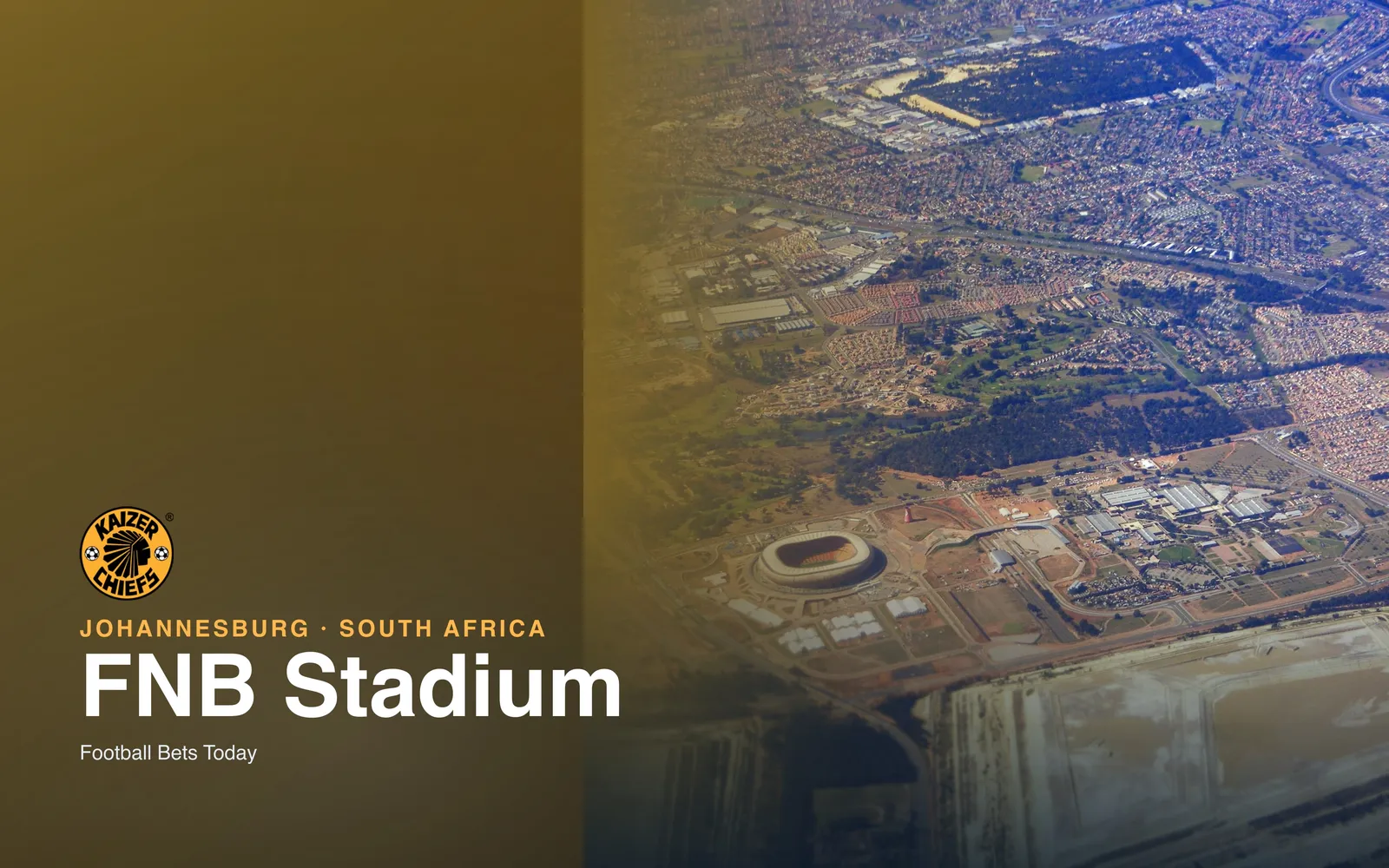
The ground
Facts
| Capacity | 94,736 |
|---|---|
| Opened | 1989 · renovated 2007-2009 (completed October 2009) for the 2010 World Cup |
| Official name | FNB Stadium, since opening on 7 October 1989 (First National Bank naming rights). Called Soccer City, or 'the Calabash', around the 2010 World Cup. |
| Surface | grass |
| Owner | City of Johannesburg |
| Record attendance | 94,807 · Kaizer Chiefs vs Orlando Pirates (2015) |
| Getting there | In Nasrec, south-west of central Johannesburg, near the M1 and N1 motorways. I did not verify the rail or bus details. |
Tenants
Who plays here
- Kaizer Chiefs
- South Africa national football team
- South Africa national rugby union team
History
Matches it is known for
- Nelson Mandela's first Johannesburg speech after his release, 1990
- Funerals of Chris Hani and Oliver Tambo, 1993
- Africa Cup of Nations final won by South Africa, 1996
- FIFA World Cup opening match and final (Spain beat Netherlands), 2010
- Africa Cup of Nations final, 2013
- Nelson Mandela memorial service, 2013
In depth
About FNB Stadium
Key takeaways
- FNB Stadium in Nasrec, Johannesburg, has held 94,736 people since its rebuild was completed in 2009, and it is the largest stadium in Africa.
- Soccer City and FNB Stadium are the same ground, and the Soccer City name was used for the 2010 World Cup because FIFA does not allow sponsored stadium names at its tournaments.
- The record crowd is 94,807, at Kaizer Chiefs v Orlando Pirates on 1 August 2015.
- The ground hosted the 1996 Africa Cup of Nations final, the 2010 World Cup final and the 2013 AFCON final, which Nigeria won.
- On big match days, travel by Rea Vaya or event transport and read the official traffic notice first, because vehicle exclusion zones are common.
FNB Stadium is Africa's biggest soccer ground, and it has held 94,736 people since its rebuild was completed in October 2009. It stands in Nasrec on the edge of Soweto in Johannesburg, Gauteng, and it is the home of Kaizer Chiefs and the usual venue of the Soweto Derby. Bafana Bafana bring their biggest matches here, and it hosted the 2010 World Cup final under the name Soccer City. If South African soccer had a family home where everyone gathers for the big occasions, this would be it.
Soccer City and FNB Stadium are the same ground. The stadium opened on 7 October 1989. However, FIFA does not allow sponsored stadium names at its tournaments, so the ground became Soccer City for the 2010 World Cup, and that name travelled around the world. South Africans also call it the Calabash, after the African calabash pot that inspired the rebuilt bowl, so fnb stadium soccer city, soccer city fnb stadium and the Calabash all lead to one address.
What Is the Capacity of FNB Stadium in Johannesburg?
FNB Stadium holds 94,736, the figure set by the rebuild for the 2010 World Cup, and that makes it the largest stadium in Africa. So, why do other numbers appear? The most common is 84,490, the maximum during the 2010 World Cup, when large blocks were reserved for media and VIP seating. That figure belonged to one tournament, and the layout for a concert, a rugby test or a cup final can change the seats on sale again, so the capacity and the crowd on the day are two separate numbers.
The record attendance is 94,807, set at Kaizer Chiefs v Orlando Pirates on 1 August 2015, which is more than the stated capacity and says everything about the pull of a Soweto Derby. It could be argued that few fixtures in African club soccer fill a ground of this size as reliably. If you want the short answer on the fnb stadium johannesburg capacity, it is 94,736 people (2009), with 94,807 as the record crowd (2015).
Who Plays at FNB Stadium?
FNB Stadium is the home ground of Kaizer Chiefs, and Amakhosi supporters in gold and black treat Nasrec as their own front room. Bafana Bafana bring their biggest fixtures here, and the Soweto Derby against Orlando Pirates usually lands at the ground because no other venue in the country can hold the demand from both sides. The Buccaneers fill their end in black and white, and the meeting of those two colours is what many people outside South Africa picture when they think of the PSL.
The ground also serves the national rugby union side, which played its first test here on 21 August 2010, a 22 to 29 result against New Zealand, and it has held funerals and memorials of national importance. The fixtures and results modules above list what is coming to Nasrec, with the competition, date and kick off time for each, and they update after every match. Read them for the next event, and treat the history further down as the background that explains why the ground matters.
How Do I Get to FNB Stadium?
Rea Vaya, the city's bus rapid transit, is the first thing to check when planning travel to FNB Stadium on a big match day, and the City of Johannesburg ran reduced fare services to FNB Stadium for the Soweto Derby in 2026. Transport arrangements change from one event to the next, so read the official transport notice for your match before choosing your route.
Driving comes last for a reason. For the Soweto Derby on 31 October 2026, FNB Stadium was declared a vehicle exclusion zone, which keeps general traffic away from the immediate area, and big events often bring similar arrangements, so read the official traffic notice for your match before you decide to drive or look for parking. Plan to arrive early, because security checks and the walk from drop off points take time, and agree a meeting point and a route home before kick off, since the first half hour after the final whistle is usually the slowest.
Why Does Soccer City Matter So Much to African Soccer?
Perhaps no ground in the country carries more of South Africa's story. Bafana Bafana opened the 1996 Africa Cup of Nations here on 13 January 1996 with a 3 to 0 win over Cameroon, and then beat Tunisia 2 to 0 in the final at the same ground. Fourteen years later the 2010 World Cup began here on 11 June 2010, with South Africa 1 to 1 Mexico, and it ended here on 11 July 2010, when Spain beat the Netherlands 1 to 0 after extra time.
For readers elsewhere on the continent the ground has its own meaning. The Super Eagles won the 2013 Nations Cup final here, beating Burkina Faso 1 to 0 on 10 February 2013, and Nigerian fans keep a real attachment to Soccer City because of it. The Black Stars played twice here at the 2010 World Cup. They lost 1 to 0 to Germany on 23 June 2010, then drew 1 to 1 with Uruguay in the quarter final on 2 July 2010 before going out 4 to 2 on penalties. Reaching that quarter final put Ghana among the last eight teams at the 2010 World Cup.
The stadium belongs to political history as well. The funerals of Chris Hani on 19 April 1993 and Oliver Tambo on 2 May 1993 were held here, and Mandela made his last public appearance at the closing ceremony of the 2010 World Cup. The national memorial service for him was held at the ground on 10 December 2013, which is why even an empty Calabash carries weight.
| Year | Event |
|---|---|
| 1989 | Opens on 7 October, after groundbreaking in 1986 |
| 1993 | Funerals of Chris Hani (19 April) and Oliver Tambo (2 May) |
| 1996 | South Africa open the Africa Cup of Nations against Cameroon (13 January) and win the final against Tunisia |
| 2009 | Calabash rebuild completed on 21 October, with a capacity of 94,736 |
| 2010 | As Soccer City, hosts the World Cup opener (11 June), Ghana v Uruguay quarter final (2 July) and final (11 July); first rugby test (21 August) |
| 2013 | Nigeria win the AFCON final (10 February); Nelson Mandela memorial service (10 December) |
| 2015 | Record attendance of 94,807 at Kaizer Chiefs v Orlando Pirates (1 August) |
| 2017 | Crush before Chiefs v Pirates on 29 July; crowd management becomes central to derby guidance |
How Did FNB Stadium Become the Calabash?
FNB Stadium opened on 7 October 1989, after ground was broken in 1986, and it served as the country's big occasion venue through the 1990s. The 2010 World Cup brought a major rebuild that ran from 2007 to 2009 and was completed on 21 October 2009, and the new bowl took its shape from the African calabash pot. That design gave the ground its nickname, and the Calabash is still what many South Africans call it.
The renaming sits on top of the rebuild. The ground opened on 7 October 1989, answered to Soccer City for the World Cup because FIFA does not allow sponsored names at its tournaments, and returned to FNB Stadium afterwards. So, if an old ticket says Soccer City and a new one says FNB Stadium, nothing has moved: the grass pitch, the bowl and the Nasrec address are the same.
Why Is FNB Stadium in Nasrec and Not Soweto?
FNB Stadium sits in Nasrec, which borders Soweto, which is why people call it a Soweto ground even though its address is not inside Soweto proper. For supporters of the two big Soweto clubs the distinction hardly matters, because the stadium is close enough to feel like home for both. The searches fnb stadium johannesburg, fnb stadium gauteng and fnb stadium south africa all point to the same place, with Joburg, Jozi and JHB as the everyday short forms.
What Is Soweto Derby Day Like at FNB Stadium?
Derby day is the biggest regular occasion at the ground. Supporters arrive early in club colours, Amakhosi in gold and black and the Bucs in black and white, and the build up runs through fan marches, taxi convoys and braai gatherings across Soweto. Inside, the noise of a full Calabash makes conversation hard, and pride matters more than the log for those ninety minutes, because whatever the log says before kick off, these two sides have taken points off each other often enough that nobody walks in certain.
Safety deserves a place in your plans. A crush before the Chiefs v Pirates match on 29 July 2017 killed two people and injured 17, which is why crowd management and early arrival feature in derby guidance. Buy your ticket well before the day through the official channels announced by the home club, or by the national federation for Bafana Bafana matches, since derby tickets can sell out. Check the date and gate on your ticket against the fixtures module before you travel, and allow time for the queues. At the gates, follow the stewards and keep children close.
How Do Fans in Nigeria, Kenya, Ghana and Uganda Follow Matches at FNB Stadium?
Most readers in Nigeria, Kenya, Ghana and Uganda follow FNB Stadium matches on pay TV, streaming or radio, and the fixtures module gives every kick off in SAST, WAT, EAT and GMT together. As a guide, SAST is one hour ahead of WAT in Lagos, two hours ahead of GMT in Accra and one hour behind EAT in Nairobi and Kampala. Where to watch in each country sits in the country data above, since broadcast arrangements change, and with players from across the continent in PSL squads, a Premiership night in Nasrec can easily feature someone from your own country.
Kenya and Uganda are joint hosts of AFCON 2027 with Tanzania, so East African readers will naturally set their own stadium plans against Africa's largest ground. Our soccer stadiums section keeps each venue on its own page, and before any big trip to Nasrec, open the fixtures module for the confirmed date and kick off time, then read the transport notice for that match.
FAQ
What is the capacity of FNB Stadium?
FNB Stadium holds 94,736 people, the figure set by the rebuild completed in 2009, which makes it the largest stadium in Africa. During the 2010 World Cup the maximum was 84,490 because of reserved media and VIP seating. The record attendance is 94,807, at Kaizer Chiefs v Orlando Pirates in 2015.
Who plays at FNB Stadium?
Kaizer Chiefs use FNB Stadium as their home ground, and Bafana Bafana play their biggest matches there. The Soweto Derby between Chiefs and Orlando Pirates is usually staged at the ground, and the national rugby union side played its first test there in 2010.
How do I get to FNB Stadium?
Start with Rea Vaya and check the official transport notice for your event before choosing your route. Big matches often bring a vehicle exclusion zone around the ground, as the Soweto Derby did on 31 October 2026. Read the official transport notice for your match before you leave, and plan your journey home at the same time.
Are Soccer City and FNB Stadium the same ground?
Yes. Soccer City and FNB Stadium are the same ground in Nasrec, Johannesburg. The stadium opened on 7 October 1989 and used the Soccer City name for the 2010 World Cup because FIFA does not allow sponsored stadium names at its tournaments. Its Calabash nickname comes from the African calabash pot that inspired the rebuilt bowl.
Written by Thabo Mokoena, 2026-11-11.