
Kumasi, Ghana · opened 1959
Capacity 40,528. Who plays here, the matches it is known for, and how to get there.
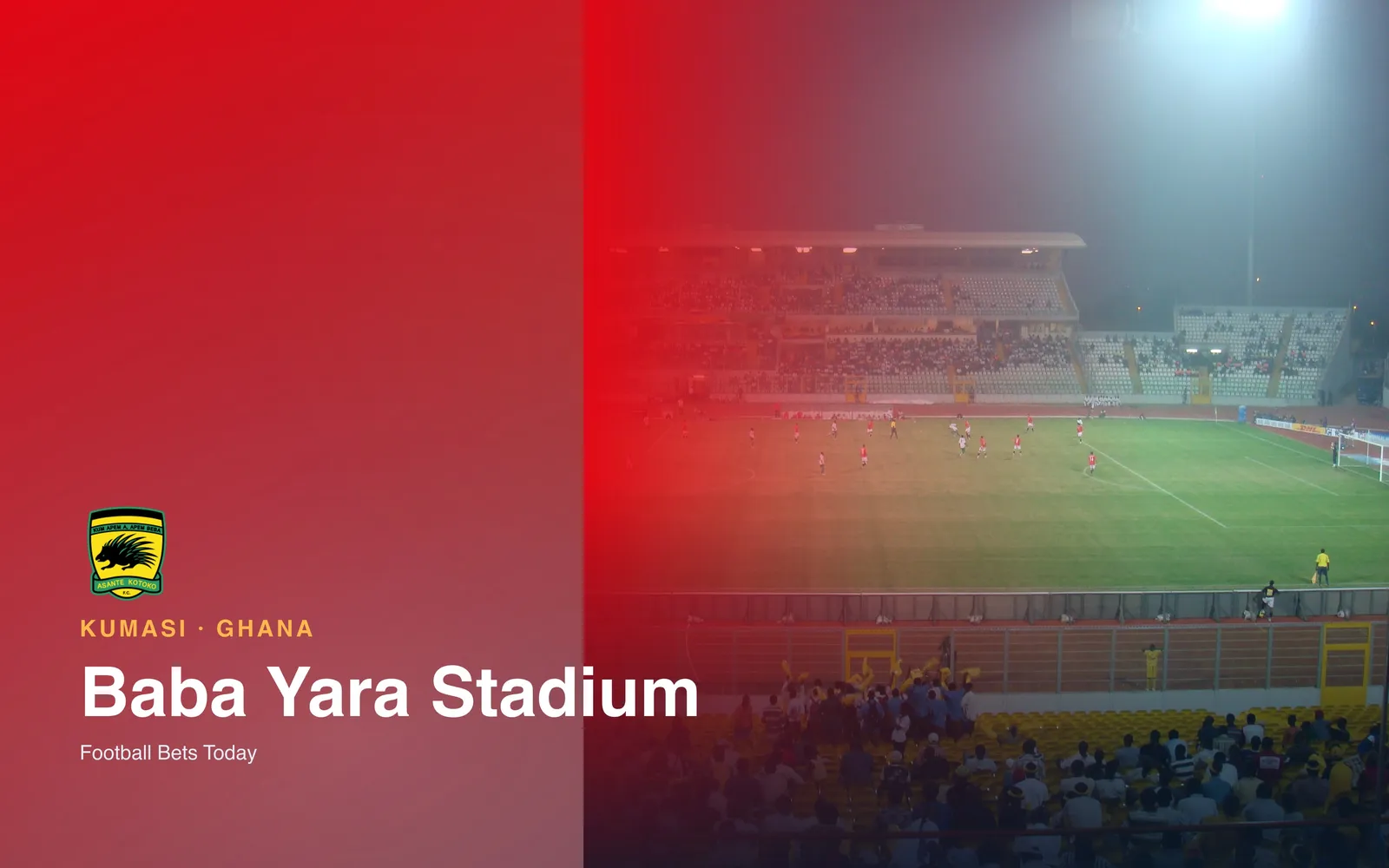
The ground
Facts
| Capacity | 40,528 |
|---|---|
| Opened | 1959 · renovated 2007–08 for the 2008 Africa Cup of Nations |
| Official name | Baba Yara Sports Stadium (Kumasi Sports Stadium) |
| Surface | grass |
| Owner | Government of Ghana (National Sports Authority) |
| Getting there | In central Kumasi, reached by road from the city centre by taxi or trotro. |
History
Matches it is known for
- Matches at the 2008 Africa Cup of Nations
- Ghana v Nigeria, 2022 World Cup play-off first leg, March 2022
- Asante Kotoko home league and continental fixtures
- Named after Ghanaian footballer Baba Yara
In depth
About Baba Yara Stadium
Key takeaways
- Baba Yara Stadium has a listed capacity of 40,528, making it Ghana’s largest stadium.
- Baba Yara Stadium was previously known as Kumasi Sports Stadium, the name used before the 2004 renaming.
- CAF withdrew the stadium’s Category 3 approval in September 2024 and rejected it for Kotoko’s October 2025 Confederation Cup tie.
- The ground hosted Africa Cup of Nations matches in 1978, 2000 and 2008, alongside Ghana’s World Cup play off against Nigeria in 2022.
Baba Yara Stadium is a football ground in Kumasi, in Ghana’s Ashanti Region, with a listed capacity of 40,528. It is Ghana’s largest stadium, associated with Asante Kotoko and the Black Stars, and known to football and soccer followers across Africa.
Its listed capacity of 40,528 places it at the centre of Ghana’s stadium landscape, with a history shaped by club and international football. Opened as a football pitch in 1959, the ground hosted Africa Cup of Nations matches in 1978, 2000 and 2008.
What Is the Capacity of Baba Yara Stadium?
Baba Yara Stadium has a listed capacity of 40,528, the largest figure for a stadium in Ghana. An attendance at a particular match measures something different from the stadium’s listed capacity.
The 2022 World Cup play off against Nigeria was played in front of 40,000. Kumasi Sports Stadium, the name used before the 2004 renaming, and Baba Yara Stadium mean this same ground in Kumasi, rather than separate venues with different seating totals.
Who Plays at Baba Yara Stadium?
Asante Kotoko are the club most closely associated with Baba Yara. Founded on 31 August 1935, Kotoko’s Porcupine Warriors identity gives the ground its strongest club connection. Their African Cup of Champions Clubs titles in 1970 and 1983 explain why continental home fixtures matter so much to supporters: Kumasi belongs within that story, alongside the players and results.
The Ghana national team have also staged home internationals here, including the Nigeria play off in 2022. These associations do not establish the venue for every subsequent match. Domestic use and CAF approval are separate questions, so read the ground named against each fixture. That distinction matters when a club’s nominal home tie takes place away from its usual stadium.
What Did CAF’s Approval Decisions Mean for Fixtures?
CAF withdrew Baba Yara’s Category 3 approval on 11 September 2024, meaning the ground could no longer stage matches requiring that approval. The decision followed the Ghana v Angola qualifier on 5 September 2024. CAF identified technical infractions, mainly an unsuitable playing field.
Category 3 is CAF’s stadium grading terminology, with approval relevant to the international and continental fixtures assigned to that standard. In October 2025, CAF also rejected Baba Yara for Kotoko’s Confederation Cup home tie against Wydad, which moved to Accra Sports Stadium. Renovation alone does not establish approval: CAF said a further inspection would follow a Ghana Football Association request, at the association’s expense, and offered an international pitch consultant.
How Do I Get to Baba Yara Stadium?
Baba Yara Stadium is in Kumasi, in Ghana’s Ashanti Region. Kumasi Sports Stadium, the name used before the 2004 renaming, refers to the same ground. The stadium’s west stand was upgraded in 2008 with press, corporate and VIP facilities.
Confirm the venue named for the fixture before arranging travel to Kumasi. In October 2025, Kotoko’s Confederation Cup home tie against Wydad moved to Accra Sports Stadium, showing why a home fixture does not always take place at the club’s usual ground.
Who Was Baba Yara, and Why Does the Stadium Carry His Name?
The stadium was renamed in 2004 to honour Baba Yara, the Kumasi born Ghana international whose career linked Kotoko and the national side. Born on 12 October 1936, he played for Kotoko from the middle of the 1950s until 1961. His Ghana career ran from 1955 to 1963 and brought 49 caps and an Africa Cup of Nations win in 1963, giving the name above the ground a direct connection to Ghanaian football.
A road accident in the Volta Region in 1963 caused a spinal injury and ended his playing career. He died in Accra on 5 May 1969. For readers outside Ghana, this is the person behind the fixture venue: a footballer remembered through both club and country. The older name, Kumasi Sports Stadium, remains useful when reading accounts written before the renaming.
How Did Kumasi Sports Stadium Develop?
The ground opened as a football pitch in 1959, before successive building programmes shaped the stadium recognised today. Construction began in 1957, the first stands followed in 1971, and a rebuild took place in 1977. Those dates explain why an opening year alone tells only part of its history. The structure developed over decades as Kumasi’s role in Ghanaian and African football expanded.
After the 2004 renaming, major works finished in 2008 for the Africa Cup of Nations. The west stand became a two tier structure with press, corporate and VIP facilities, while transparent panels helped separate spectators from the playing area. When comparing football stadiums, distinguish the original opening from later reconstruction: Baba Yara’s football history and its seating infrastructure have different starting points.
| Year | Milestone |
|---|---|
| 1959 | Opened as a football pitch |
| 1971 | First stands built |
| 1977 | Stadium rebuilt |
| 2004 | Renamed after Baba Yara |
| 2008 | Major stadium works completed |
| 2024 | CAF withdrew Category 3 approval |
| 2025 | Kotoko’s October Confederation Cup home tie moved to Accra |
Which African Matches Made Baba Yara Famous?
Baba Yara’s tournament history reaches across West, East and Southern Africa through the 1978, 2000 and 2008 AFCON editions. In 1978, Kumasi hosted group matches and Uganda’s semi final against Nigeria, as the Cranes progressed towards the final. Ghana beat Uganda 2 to 0 in the 1978 final in Accra. South Africa supplied another defining result in 2000, when Bafana Bafana beat hosts Ghana 1 to 0 in their quarter final in Kumasi.
The 2008 programme included Egypt’s 4 to 2 win against Cameroon and South Africa’s 1 to 1 draw with Senegal. Nigeria’s strongest recent historical connection is the goalless World Cup play off first leg on 25 March 2022. Ghana then drew 1 to 1 in Abuja and advanced on away goals under that tie’s rules. The Kumasi result mattered because it left qualification to be settled in Nigeria.
What Should Visitors Expect on Matchday?
The west stand became a two tier structure during the stadium works completed in 2008 for the Africa Cup of Nations. Those upgrades added press, corporate and VIP facilities, while transparent panels helped separate spectators from the playing area.
Confirm the venue before paying for travel: Kotoko’s October 2025 switch to Accra shows why the club name alone cannot tell you which stadium to approach. That Confederation Cup home tie against Wydad moved to Accra Sports Stadium after CAF’s decision on Baba Yara.
How Can Fans Across Africa Follow Matches From Kumasi?
Fans in Ghana, Nigeria, Kenya, South Africa and Uganda should use the fixture’s country specific viewing information for television, radio or streaming coverage. Availability depends on the competition and the match, so a stadium name does not establish a broadcaster. Check that the listed venue is Baba Yara before treating a Ghana or Kotoko home fixture as a match taking place in Kumasi.
Read the kick off listing in WAT, EAT, SAST and GMT together, then select the zone used where you are watching. Ghana uses GMT, Nigeria WAT, South Africa SAST, and Kenya and Uganda EAT. For travelling supporters, the practical order is venue first, ticket arrangements next, then transport. Recheck the organiser’s fixture notice before setting off.
FAQ
What is the capacity of Baba Yara Stadium?
Baba Yara Stadium has a listed capacity of 40,528, making it Ghana’s largest stadium.
Who plays at Baba Yara Stadium?
Baba Yara is associated with Asante Kotoko and Ghana’s national team, the Black Stars. CAF approval affects its availability for international and continental matches, so confirm the venue listed for each fixture.
How do I get to Baba Yara Stadium?
Baba Yara Stadium is in Kumasi, in Ghana’s Ashanti Region. Confirm the fixture’s named venue before arranging travel: Kotoko’s October 2025 Confederation Cup home tie against Wydad moved to Accra Sports Stadium.
Why is the stadium called Baba Yara Stadium?
The stadium was renamed in 2004 to honour Baba Yara, the Kumasi born Ghana international who played for Asante Kotoko. He earned 49 caps for Ghana and won the Africa Cup of Nations in 1963. Before the renaming, the ground was known as Kumasi Sports Stadium.
Written by Esi Owusu, 2026-11-11.