
Forward · Nigeria · born 1976
Career by season, honours, the Super Eagles record and the reported net worth, with the current club and this season's numbers in the modules.
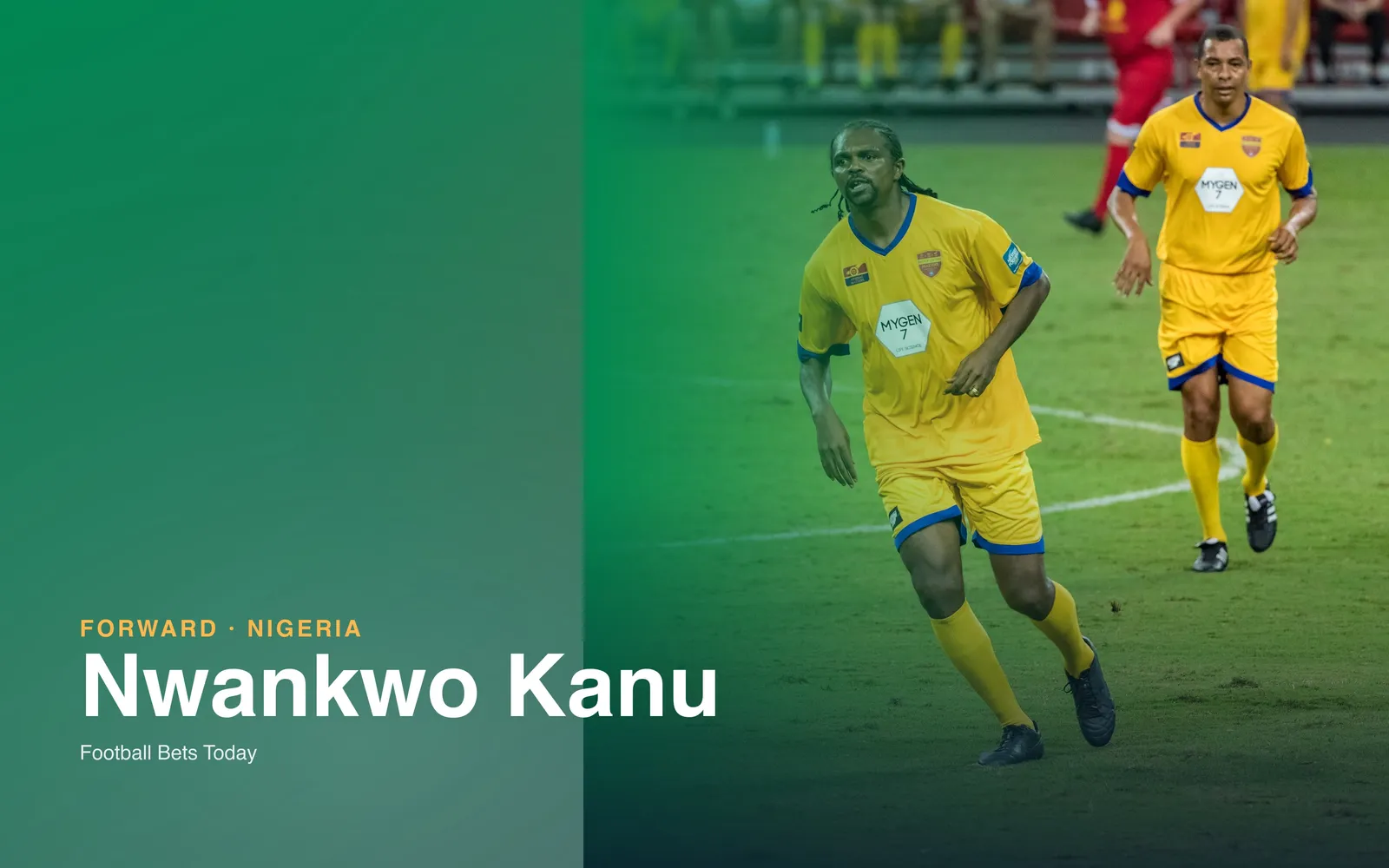
Career
Clubs by season
| Club | From | To | Apps | Goals | Note |
|---|---|---|---|---|---|
| Iwuanyanwu Nationale | 1992 | 1993 | 25 | 15 | permanent |
| Ajax | 1993 | 1996 | 54 | 25 | permanent |
| Inter Milan | 1996 | 1999 | 12 | 1 | permanent |
| Arsenal | 1999 | 2004 | 119 | 30 | permanent |
| West Bromwich Albion | 2004 | 2006 | 53 | 7 | permanent |
| Portsmouth | 2006 | 2012 | 143 | 20 | permanent |
Appearances and goals are to the end of the last completed season; this season's numbers load from the feed.
Super Eagles
Debut 1994 · 86 caps · 12 goals (to 2012)
Honours
- UEFA Champions League 1994-95 · Ajax
- Eredivisie 1993-94, 1994-95, 1995-96 · Ajax
- UEFA Cup 1997-98 · Inter Milan
- Premier League 2001-02, 2003-04 · Arsenal
- FA Cup 2001-02, 2002-03 · Arsenal
- FA Cup 2007-08 · Portsmouth
- Olympic gold medal 1996 · Nigeria U23
- African Footballer of the Year 1996 and 1999
- BBC African Footballer of the Year 1997 and 1999
Reported net worth
GBP 7.49 million (Pulse Nigeria (published 22 Feb 2025), 2025)
Salary: No current salary (retired). Pulse (2025) reports historical weekly pay of about GBP 40,000 at Inter Milan, GBP 12,000 after his 1999 move to Arsenal and GBP 25,000 after a 2000 Arsenal contract.
Published estimates, not accounts. The figure carries its publisher and year.
In depth
About Nwankwo Kanu
Key takeaways
- Nwankwo Kanu is a retired Nigerian striker, born on 1 August 1976 in Owerri, Imo State, who left his last club, Portsmouth, on 30 July 2012.
- Kanu won 86 caps for Nigeria from his 1994 debut and captained the side to the 1996 Atlanta Olympic football gold, Africa's first in the men's event.
- His club honours include the Champions League with Ajax in 1994/95, the UEFA Cup with Inter Milan in 1997/98, two Premier League titles with Arsenal and three FA Cups.
- Pulse Nigeria estimated his net worth at about GBP 7.49 million in February 2025, and Legit.ng put it at USD 9 million to 15 million in September 2026; both are unaudited press estimates.
- Legit.ng reported in September 2026 that Kanu is executive chairman of Enyimba International FC.
Nwankwo Kanu is a retired Nigerian striker, born on 1 August 1976 in Owerri, Imo State, and one of the most decorated footballers Africa has produced. He plays for no club, having left Portsmouth on 30 July 2012, and he won 86 caps for Nigeria after captaining the side to Africa's first Olympic football gold in 1996. For readers in South Africa who grew up on Premier League soccer, he is the tall Arsenal forward of 1999 to 2004 who seemed to score from angles nobody else could see.
Kanu began his club career at Iwuanyanwu Nationale in Owerri and joined Arsenal in 1999. Between those milestones, he captained Nigeria to Olympic gold in 1996 and underwent heart surgery that November. His return brought further honours, including the winning goal for Portsmouth in the 2008 FA Cup final.
Who Is Nwankwo Kanu?
Nwankwo Kanu is a Nigerian forward whose honours span Dutch league titles, European trophies, English league and cup wins, and Olympic gold. He was African Footballer of the Year in 1996 and 1999. His birthplace, Owerri, also connects his story to Iwuanyanwu Nationale, the Nigerian club where his senior career began.
He was born on 1 August 1976 in Owerri, Imo State. His Nigeria career began in 1994, while his final club appearance came during his Portsmouth years, before his departure on 30 July 2012.
His career is best understood through those different settings. Owerri supplies the starting point, Nigeria gives his achievements their national significance, and his European clubs show how his technique translated across competitions. For African readers discovering him through an Arsenal highlight or a Portsmouth cup goal, the Nigerian part of that story deserves equal attention.
The Road From Owerri: Kanu's Club Career
Kanu's road ran from Iwuanyanwu Nationale in Owerri to Ajax, Inter Milan, Arsenal, West Bromwich Albion and Portsmouth. At Iwuanyanwu Nationale he scored 15 league goals in 25 appearances, establishing his senior record in Nigerian football before moving to Europe.
At Ajax, Kanu scored 25 league goals in 54 appearances. The Nigerian forward collected a Champions League winner's medal in 1994/95, adding a European club honour before his Olympic success with Nigeria in 1996.
His Inter Milan league record comprised 12 appearances and one goal. Arsenal brought him to London in 1999, and he went on to play 119 league games and score 30 goals. His Arsenal honours included Premier League titles in 2001/02 and 2003/04 and FA Cups in 2001/02 and 2002/03.
West Bromwich Albion brought another 53 league appearances and 7 goals. His final club, Portsmouth, accounted for 143 league games and 20 goals before his departure on 30 July 2012. Across those six clubs, his league record totals 406 appearances and 98 goals. The table below sets out the league numbers club by club, to the end of the 2011/12 season.
Read those figures as league totals: European ties, domestic cup matches and Nigeria appearances sit outside their scope. That distinction matters especially for Kanu, whose 2008 Portsmouth cup goals are central to his reputation. A league scoring column alone cannot convey the significance of a goal that decides a semi final or a final.
| Club | League appearances | League goals |
|---|---|---|
| Iwuanyanwu Nationale | 25 | 15 |
| Ajax | 54 | 25 |
| Inter Milan | 12 | 1 |
| Arsenal | 119 | 30 |
| West Bromwich Albion | 53 | 7 |
| Portsmouth | 143 | 20 |
| Career total | 406 | 98 |
Why Did Kanu Need Heart Surgery at 20?
After captaining Nigeria to gold at the 1996 Olympics, Kanu underwent a medical at Inter Milan that revealed a heart defect. He had surgery in Cleveland, USA, in November 1996 and returned to playing in 1997. In March 2014 he had a second corrective operation at the same hospital in Ohio, which his foundation described as routine.
His recovery forms a significant part of a career that continued until his Portsmouth departure in 2012. After the 1996 operation, he went on to win the UEFA Cup with Inter Milan in 1997/98, league titles with Arsenal in 2001/02 and 2003/04, and the FA Cup with Portsmouth in 2008.
The dates help explain why his story reaches beyond a list of trophies. His Olympic captaincy and first operation both belong to 1996, placing a major sporting achievement and a major health event within the same year. The honours that followed give his return a clear footballing chronology without making his individual recovery a guide to anyone else's health.
What Did Kanu Do on the Pitch?
Kanu was a second striker who did his best work between the lines, using his reach and close control to keep the ball where defenders expected to win it. His game was built on touch and patience. Many of his goals came from waiting a fraction longer than the goalkeeper, which is why he so often finished from positions that looked closed.
One defining performance came in October 1999, when Arsenal trailed Chelsea by two goals and Kanu struck three times in 15 minutes to secure a 3 to 2 victory. It provides a specific example of the Nigerian forward deciding a Premier League match through close control and inventive finishing.
Three years earlier, he scored the winner as Nigeria beat Brazil 4 to 3 in the 1996 Olympic semi final in Atlanta, the goal that opened the way to gold. Later, with Portsmouth in 2008, he scored the only goal of the FA Cup semi final against West Bromwich Albion, his former club, and repeated that feat in the final against Cardiff City.
For a young forward, the lesson is that a tall player does not have to play a tall player's game. If you are watching old clips, look at his first touch and where his body is before the pass arrives, because that is where the goals were made. His career offers readers exploring African footballers a distinctive example of close control combined with reach.
Kanu and the Super Eagles: Debut, Atlanta Gold and 86 Caps
Kanu made his Nigeria debut in 1994 and won 86 senior caps. His international achievements also include captaining the Olympic side to gold in Atlanta in 1996.
Atlanta remains central to his international story: Nigeria became the first African side to win men's Olympic football gold in 1996. Kanu scored the winner in the 4 to 3 semi final victory over Brazil, helping Nigeria reach the final and ultimately claim the title.
The personal importance of that medal emerged in an AFP report in January 2019. Kanu said the saddest day of his life came when his medals went missing, including his 1996 Olympic gold.
His 86 senior caps and Olympic captaincy belong alongside his club honours when assessing his career. Together, they connect his beginnings in Owerri with achievements for Nigeria and clubs in European football.
Keep the senior and Olympic records distinct when comparing Nigerian internationals. The 86 caps describe his senior international career; the Atlanta medal identifies a separate tournament achievement. For supporters in Ghana, Kenya, South Africa and Uganda, Nigeria's 1996 breakthrough also provides a shared African milestone through which to understand his standing beyond his own country.
Nwankwo Kanu net worth
Pulse Nigeria estimated Nwankwo Kanu's net worth at about GBP 7.49 million in February 2025, and Legit.ng put it at USD 9 million to 15 million in September 2026, with neither outlet naming who produced its figure. Both are unaudited press estimates rather than accounts.
Kanu has no current salary, and Pulse Nigeria listed his salary as 'retired' in its February 2025 profile. The same outlet reported, without naming a source, that he earned about GBP 40,000 a week at Inter Milan, about GBP 12,000 a week on joining Arsenal in 1999 and about GBP 25,000 a week on a new Arsenal deal in 2000. Those reported wages describe historical earnings in pounds.
The cited reports provide no endorsement fee or image rights figure.
Legit.ng reported in September 2026 that Kanu had property interests in Lagos, Abuja and London and held the executive chairman role at Enyimba International FC. Those reported interests provide context for its estimate, but do not establish a verified total for his wealth.
The currencies and publication dates also matter. A pound estimate and a dollar range cannot be compared directly without a dated exchange rate, and their difference does not establish a change in wealth. Historical wages, meanwhile, cannot simply be added together to calculate net worth: that would require a fuller account of assets and liabilities.
How to Watch Kanu From Nigeria, Kenya, South Africa, Ghana and Uganda
Kanu no longer plays, so watching his football means archive footage. Legit.ng reported in September 2026 that he is executive chairman of Enyimba International FC. Enyimba's fixtures module lists their matches with dated kick off times.
Read fixture clocks in this order: WAT for Nigeria, EAT for Kenya and Uganda, SAST for South Africa, and GMT for Ghana. For example, the same kick off can be displayed as 16:00 WAT / 18:00 EAT / 17:00 SAST / 15:00 GMT. Check the dated listing alongside its country specific broadcaster entry when planning your viewing.
For readers in Nigeria, Kenya, South Africa, Ghana and Uganda, the October 1999 hat trick against Chelsea and the 2008 FA Cup final offer two useful starting points. Watch his first touch in both, then compare those club performances with his decisive goal for Nigeria against Brazil at the 1996 Olympics.
FAQ
What is Nwankwo Kanu's net worth?
Pulse Nigeria estimated Nwankwo Kanu's net worth at about GBP 7.49 million in February 2025, and Legit.ng put it at USD 9 million to 15 million in September 2026. Neither outlet named who produced its figure, so both are unaudited press estimates rather than accounts. Legit.ng also reported property interests in Lagos, Abuja and London.
Which club does Nwankwo Kanu play for?
Nwankwo Kanu plays for no club, because he retired after leaving Portsmouth on 30 July 2012. Legit.ng reported in September 2026 that he is executive chairman of Enyimba International FC in the Nigerian league.
How many caps does Nwankwo Kanu have?
Nwankwo Kanu won 86 senior caps for Nigeria after making his debut in 1994. He also captained Nigeria's Olympic side to gold in Atlanta in 1996.
Why did Nwankwo Kanu have heart surgery?
An Inter Milan medical after the 1996 Olympics revealed a heart defect. Kanu underwent surgery in Cleveland, USA, in November 1996 and returned to playing in 1997.
Written by Tunde Akinwande, 2026-11-11.
Guides