
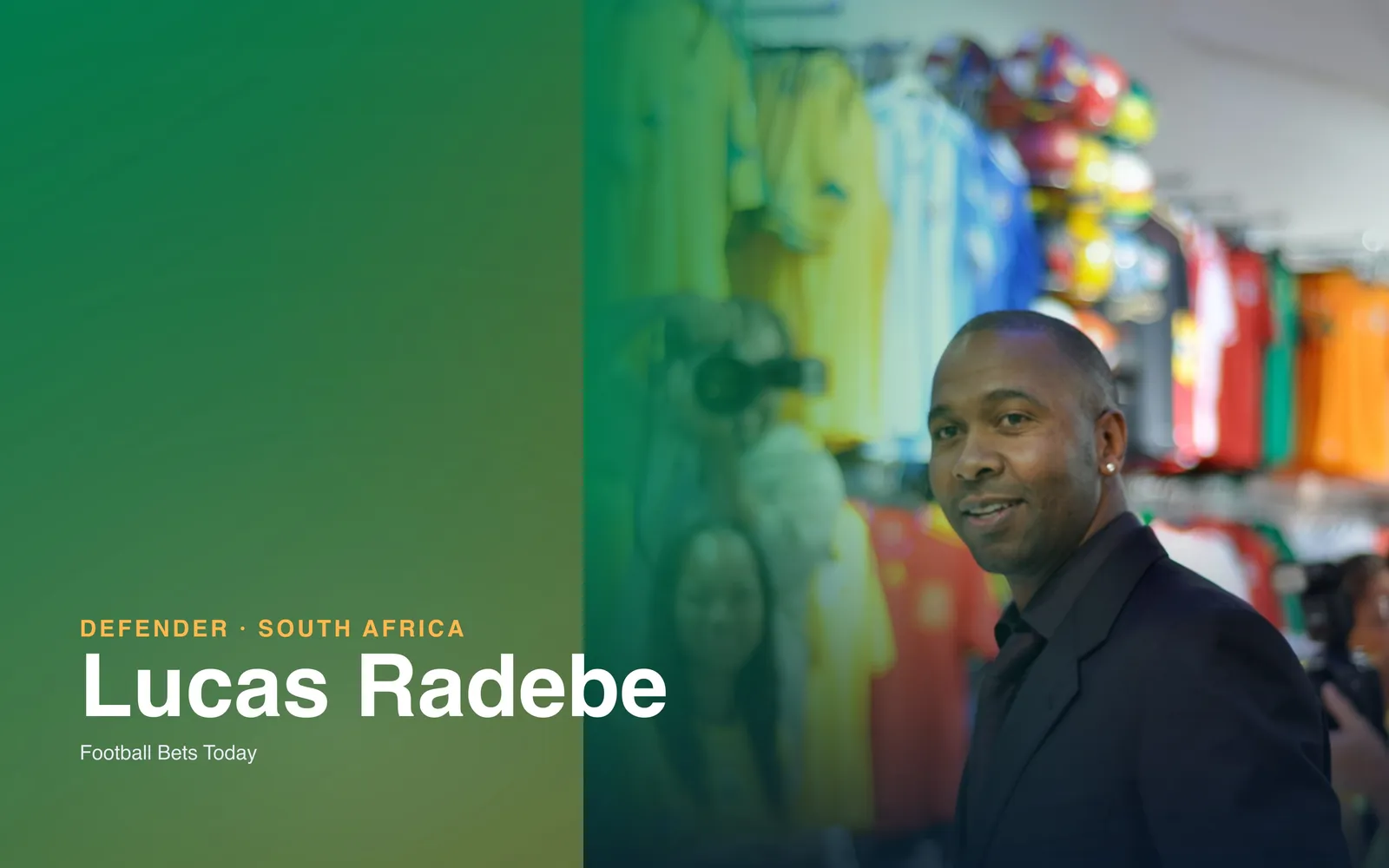
Defender · South Africa · born 1969
Career by season, honours, the Bafana Bafana record and the reported net worth, with the current club and this season's numbers in the modules.
Career
Clubs by season
| Club | From | To | Apps | Goals | Note |
|---|---|---|---|---|---|
| Kaizer Chiefs | 1989 | 1994 | 113 | 5 | permanent |
| Leeds United | 1994 | 2005 | 201 | 0 | permanent |
Appearances and goals are to the end of the last completed season; this season's numbers load from the feed.
Bafana Bafana
Debut 1992 · 70 caps · 2 goals (to 2003)
Honours
- National Soccer League 1989 · Kaizer Chiefs
- National Soccer League 1991 · Kaizer Chiefs
- National Soccer League 1992 · Kaizer Chiefs
- Africa Cup of Nations 1996 · South Africa
- League Cup (runner-up) 1995-96 · Leeds United
- Leeds United Player of the Year 1998
- FIFA Fair Play Award 2000
- PFA Merit Award 2010
- Order of Ikhamanga
Reported net worth
USD 13 million (Sports Brief, )
Salary: Not found from an accepted outlet.
Published estimates, not accounts. The figure carries its publisher and year.
In depth
About Lucas Radebe
Key takeaways
- Lucas Radebe, born in Diepkloof, Soweto on 12 April 1969, is a retired central defender known as The Chief at Leeds United.
- Radebe plays for no club, having retired in 2005 after Kaizer Chiefs from 1989 to 1994 and Leeds United from 1994 to 2005.
- Radebe won 70 caps and scored 2 goals for South Africa between 1992 and 2003, and he captained Bafana Bafana at the 1998 and 2002 World Cups.
- Briefly News published its profile in 2019 and updated it in April 2025. It says his net worth remains unknown and quotes unnamed other sources at USD 5 million and USD 13 million, both unverified estimates.
- Radebe won the 1996 Africa Cup of Nations at home and received the FIFA Fair Play Award in December 2000.
Lucas Radebe is the Soweto born central defender known to Leeds United fans as The Chief, who captained both Leeds and Bafana Bafana before he retired from soccer in 2005. He was born in Diepkloof on 12 April 1969 and won 70 caps for South Africa between 1992 and 2003. He plays for no club today, after spells at Kaizer Chiefs from 1989 to 1994 and at Leeds from 1994 to 2005.
If you only know him from the clips, picture the older brother on the street who always stood between the younger ones and trouble, because that is roughly how Elland Road came to see him. His career connects Soweto with Yorkshire, with the AFCON 1996 triumph at its heart. His honours help explain that standing; the published net worth estimates remain unverified.
Who Is Lucas Radebe?
Lucas Radebe is a retired South African centre back, and he became one of the most admired African captains in English soccer. He grew up in Diepkloof as one of 11 children. He started out as a goalkeeper, moved into midfield and then settled in central defence. That position took him from Kaizer Chiefs to Leeds United, and it put the armband on his arm for both Leeds and his country.
So, which club does Lucas Radebe play for? He plays for none, because he retired in 2005, and his testimonial at Elland Road on 2 May that year drew more than 37,000 fans. His senior career covered only two clubs, Amakhosi from 1989 to 1994 and Leeds from 1994 to 2005. Briefly News has listed him as a member of the CAF Technical and Development Committee, which keeps him connected to the game across the continent.
The Road From Diepkloof: Kaizer Chiefs, Leeds and the Reported Fee
Radebe's senior career began at Kaizer Chiefs in 1989, and within a few seasons he was a title winner. Amakhosi won the National Soccer League in 1989, 1991 and 1992 with him in the squad. In those years the league was the main event in Soweto, in much the same way the Premiership log is now.
In 1994, Leeds United signed him for a reported £250,000 alongside fellow South African Phil Masinga. That meant two Bafana Bafana players arriving in the same Yorkshire dressing room in the same year, which gave South African supporters a reason to follow English results closely. Radebe grew into a fixture of the side.
Radebe became Leeds captain in 1998, and the side he led finished fourth in 1998/99 and third in 1999/2000. That third place took Leeds into the Champions League. But, a knee injury and then ankle problems kept him out for nearly two years from 2000. As a result, he missed much of that era, even though he remained the club's skipper.
He fought his way back into the squad and stayed at Leeds until he retired in 2005, eleven years after he arrived. The table below sets out his career in dated steps, from Diepkloof to the testimonial and beyond.
| Year | Club or team | Milestone |
|---|---|---|
| 1969 | Diepkloof, Soweto | Born on 12 April, one of 11 children |
| 1989 | Kaizer Chiefs | Joins Amakhosi and wins the National Soccer League |
| 1991 | Kaizer Chiefs | Wins the league title and recovers after being shot in Soweto |
| 1992 | Kaizer Chiefs and South Africa | Wins the league title and makes his debut in a 1 to 0 win over Cameroon |
| 1994 | Leeds United | Signs for a reported £250,000 alongside Phil Masinga |
| 1996 | Leeds United and South Africa | Wins AFCON at home and plays twice in goal for Leeds |
| 1998 | Leeds United and South Africa | Becomes Leeds captain, captains South Africa at the World Cup and becomes an SOS Children's Villages ambassador |
| 2000 | Leeds United | Receives the FIFA Fair Play Award; an injury layoff of nearly two years begins |
| 2002 | South Africa | Captains South Africa at the World Cup and scores against Spain |
| 2003 | South Africa | Wins his last cap, against England on 22 May |
| 2005 | Leeds United | Retires; his testimonial on 2 May draws more than 37,000 fans |
| 2010 | Retired | Receives the PFA Merit Award |
Why Is Lucas Radebe Called The Chief?
The Chief is the name Leeds United fans gave Radebe. It could be argued that the Leeds name points straight back to Amakhosi, the club that sold him to Yorkshire. It also suited a man who took the armband in 1998 and who behaved like a senior figure long before that.
The 1996 season added another layer to the legend, because he went in goal for Leeds twice, against Middlesbrough and against Manchester United. He had started his career as a goalkeeper in Soweto, so those matches returned him to his first position, and they turned him into a cult hero at Elland Road. His readiness to fill any gap the team had explains his standing better than any statistic can.
What Did Lucas Radebe Do on the Pitch?
Radebe was a central defender whose anticipation helped him protect the space behind his defensive partner. His leadership grew from that sense of responsibility. He had played as a goalkeeper and as a midfielder before he settled in defence. Perhaps that is why he looked so comfortable stepping out with the ball, or organising the line in front of his keeper, at a time when English centre backs were often judged mainly on heading and tackling.
His defining performances can be dated. In 1998/99 and 1999/2000 he captained Leeds to fourth and then third place on the English log. In the 1996 AFCON final he played the full match as South Africa beat Tunisia 2 to 0. In 2002 he scored against Spain at the World Cup in Korea and Japan, a rare goal from a defender who seldom went forward.
His two matches in goal in 1996 belong in this list as well, because few outfield players are trusted with the gloves in a top flight match and then with the captaincy. How would a modern scout describe him? Probably as a ball playing centre back with the calm of a goalkeeper, and that is a profile academies across Africa still try to develop.
Radebe and Bafana Bafana: The 1992 Debut, AFCON 1996 and Two World Cups
Radebe won 70 caps and scored 2 goals for South Africa between 1992 and 2003, and he captained the side at the 1998 and 2002 World Cups. His debut came in 1992, in the national team's first official match after readmission, a 1 to 0 win over Cameroon. That places him in the opening chapter of Bafana Bafana history, alongside the players who rebuilt the team from its first match.
His greatest moment with the national team came at home, at the 1996 Africa Cup of Nations, which South Africa won by beating Tunisia 2 to 0 in the final. Radebe played the full match.
Radebe wore the armband at the 1998 World Cup and again in 2002. His goal against Spain in 2002 was one of the 2 he scored for his country. That is a modest total for a career of 70 caps, but it reflects how rarely a central defender of his type went forward, and it says nothing about how much he mattered to the team.
His last match was against England on 22 May 2003, by which time he had spent nine years in English soccer. The national team record module updates as matches are played, while his own 70 caps stay fixed. For readers in Nigeria, Ghana, Kenya and Uganda who compare national captains, he offers a clear template: an African skipper who also led a European club in the same years.
Lucas Radebe net worth
Briefly News published a profile in 2019 and updated it in April 2025, and it says Lucas Radebe's net worth remains unknown. That profile quotes unnamed other sources at USD 5 million and USD 13 million.
Briefly News reports no salary or endorsement figure. The quoted amounts are unverified published estimates rather than a set of accounts, and the spread from USD 5 million to USD 13 million shows how far apart those estimates are.
All of these estimates are quoted in US dollars, so their value in rand, naira, shillings or cedis changes with the exchange rate on the day you read them. If you want a local figure, multiply the dollar estimate by your bank's rate for that day. Keep in mind that a precise conversion of an imprecise estimate is still an estimate, so the result will only ever be approximate.
Leeds signed Radebe for a reported £250,000 in 1994, but that fee does not establish his personal wealth. Calculating Radebe's wealth would require valuing his assets and deducting outstanding debts. Treat both quoted estimates as unverified figures, because his net worth remains unknown.
Honours, Awards and Life Beyond the Pitch
Radebe's team honours include three National Soccer League titles with Kaizer Chiefs, in 1989, 1991 and 1992, and the 1996 Africa Cup of Nations. His individual awards say even more about him. He received the FIFA Fair Play Award in December 2000 for his work against racism and with children. He also won the PFA Merit Award in 2010.
Away from the pitch, his story includes a frightening moment in 1991, when he was shot in the back while shopping in Soweto. No vital organs were damaged, and he returned to soccer. That recovery makes everything he went on to achieve at Leeds and with Bafana Bafana all the more remarkable. In 2004, South Africans ranked him 54th in the Top 100 Great South Africans poll, which shows how far his standing reached beyond the game.
He became an ambassador for SOS Children's Villages in 1998, and in 2009 the English FA named him an ambassador for England's bid to host the 2018 World Cup. Briefly News has also listed him as a member of the CAF Technical and Development Committee, a continental role that connects him with administrators in Nigeria, Kenya, South Africa, Ghana and Uganda. Committee titles can change, so the confederation's own announcements are the place to confirm his current role.
Where Does Radebe Rank Among South African and African Defenders?
Radebe belongs among the very best defenders South Africa has produced, and among the leading African centre backs of the Premier League era. Few players from the continent captained an English club into the Champions League, and fewer still did so while also leading their national team at two World Cups. Soweto still claims him first and Leeds a close second, and both claims are fair.
For profiles of the players who followed him from the continent into the major leagues, our hub of African soccer players has the full list, including Kaizer Chiefs and Bafana Bafana names who grew up hearing his story. If you read his career alongside theirs, you can see how much wider the route from Soweto to Europe has become since he and Phil Masinga took it together in 1994.
How to Watch Radebe's Clubs From Nigeria, Kenya, South Africa, Ghana and Uganda
Archive recordings preserve Radebe's playing career, which ended with his retirement in 2005. Following Kaizer Chiefs and Leeds offers another way to explore the club connections he built between Soweto and Yorkshire. For Amakhosi viewing arrangements, consult the Chiefs fixtures module for match times and broadcaster details by country.
Radebe's Soweto beginnings make the South African clock a useful starting point for following Amakhosi. A Chiefs fixture listed at 15:30 SAST corresponds to Lagos clocks showing 14:30 WAT, Nairobi and Kampala clocks showing 16:30 EAT, and Accra clocks showing 13:30 GMT. These African offsets stay constant across the calendar, helping supporters keep up with the club where Radebe began his senior career in 1989.
Radebe's move to Leeds in 1994 added Britain's seasonal clock changes to the viewing routine for his South African followers. A winter afternoon fixture starting at 15:00 in Yorkshire translates to Soweto: 17:00 SAST; Lagos: 16:00 WAT; Accra: 15:00 GMT; Nairobi and Kampala: 18:00 EAT. With British summer time in effect, that same 15:00 local start translates to Soweto: 16:00 SAST; Lagos: 15:00 WAT; Accra: 14:00 GMT; Nairobi and Kampala: 17:00 EAT. Check the converted time on each Leeds fixture card when following the Yorkshire club that appointed Radebe captain in 1998.
FAQ
What is Lucas Radebe's net worth?
Lucas Radebe's net worth remains unknown, according to Briefly News in a profile published in 2019 and updated in April 2025. It quotes unnamed other sources at USD 5 million and USD 13 million. Briefly News reports no salary or endorsement figure, and both net worth estimates remain unverified.
Which club does Lucas Radebe play for?
Lucas Radebe plays for no club, because he retired in 2005. He played for Kaizer Chiefs from 1989 to 1994 and for Leeds United from 1994 to 2005, and his testimonial at Elland Road on 2 May 2005 drew more than 37,000 fans.
How many caps does Lucas Radebe have?
Lucas Radebe won 70 caps and scored 2 goals for South Africa between 1992 and 2003. He made his debut in 1992 in a 1 to 0 win over Cameroon. He captained Bafana Bafana at the 1998 and 2002 World Cups, and he played his last match against England on 22 May 2003.
Did Lucas Radebe win the Africa Cup of Nations?
Radebe was part of South Africa's title winning side at the 1996 Africa Cup of Nations. He played the full final as the hosts defeated Tunisia 2 to 0.
Written by Thabo Mokoena, 2026-11-11.