
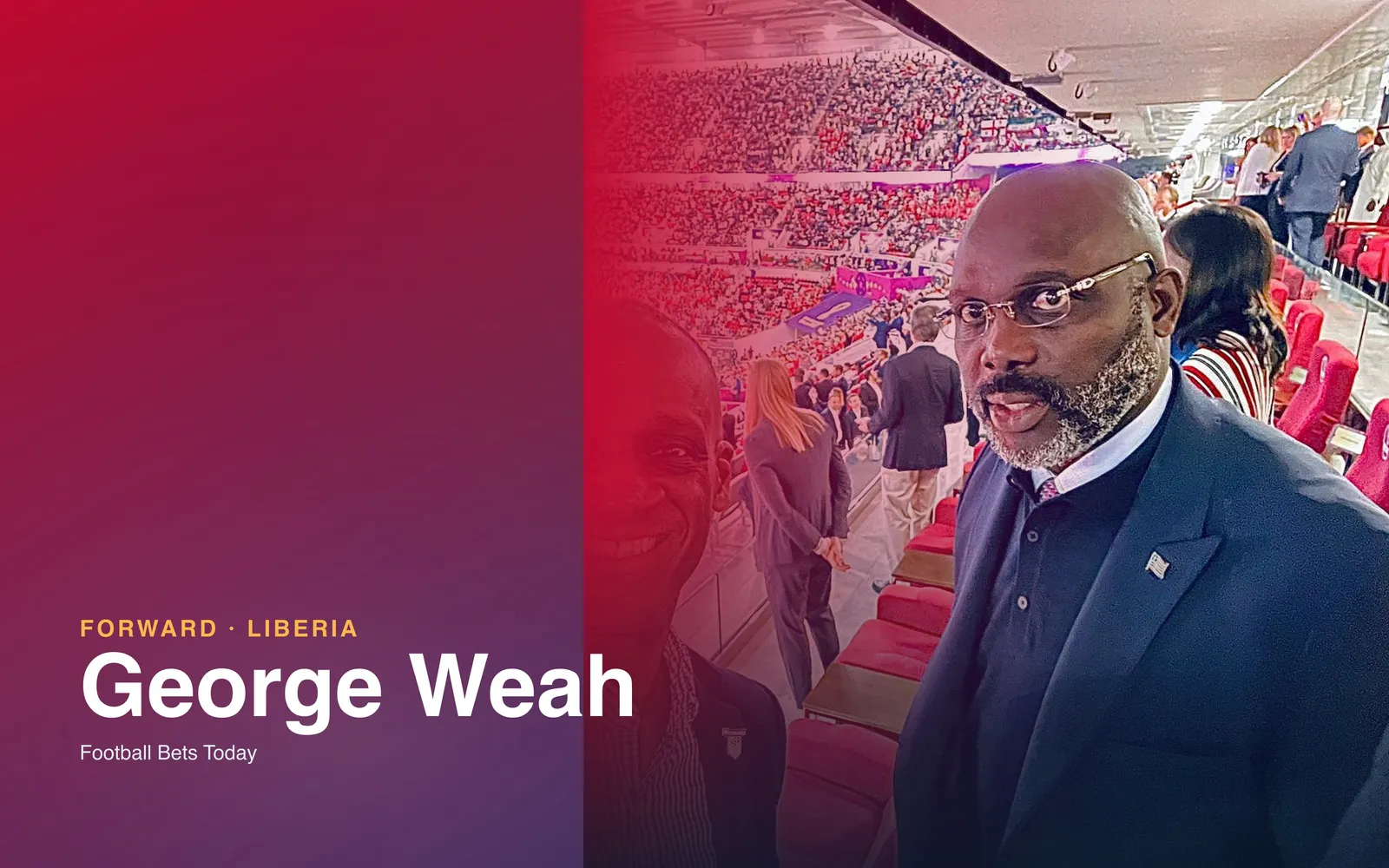
Forward · Liberia · born 1966
Career by season, honours, the Lone Star record and the reported net worth, with the current club and this season's numbers in the modules.
Career
Clubs by season
| Club | From | To | Apps | Goals | Note |
|---|---|---|---|---|---|
| Young Survivors | 1981 | 1984 | 34 | - | youth/permanent |
| Bong Range United | 1984 | 1985 | 2 | 1 | permanent |
| Mighty Barrolle | 1985 | 1986 | 10 | 7 | permanent |
| Invincible Eleven | 1986 | 1987 | 23 | 24 | permanent |
| Africa Sports | 1987 | 1987 | 2 | 1 | permanent |
| Tonnerre Yaoundé | 1987 | 1988 | 18 | 14 | permanent |
| Monaco | 1988 | 1992 | 103 | 47 | permanent |
| Paris Saint-Germain | 1992 | 1995 | 96 | 32 | permanent |
| AC Milan | 1995 | 2000 | 114 | 46 | permanent |
| Chelsea | 2000 | 2000 | 11 | 3 | loan |
| Manchester City | 2000 | 2000 | 7 | 1 | permanent |
| Marseille | 2000 | 2001 | 19 | 5 | permanent |
| Al Jazira | 2001 | 2003 | 39 | 30 | permanent |
Appearances and goals are to the end of the last completed season; this season's numbers load from the feed.
Lone Star
Debut 1986 · 75 caps · 18 goals (to 2018-09)
Honours
- Coupe de France 1990-91 · Monaco
- Division 1 1993-94 · Paris Saint-Germain
- Coupe de France 1992-93, 1994-95 · Paris Saint-Germain
- Coupe de la Ligue 1994-95 · Paris Saint-Germain
- Serie A 1995-96, 1998-99 · AC Milan
- FA Cup 1999-2000 · Chelsea
- Ballon d'Or 1995
- FIFA World Player of the Year 1995
- African Footballer of the Year 1989 and 1995
- UEFA Champions League top scorer 1994-95
- FIFA 100 (2004)
- Arthur Ashe Courage Award 2004
Reported net worth
USD 30 million to USD 90 million (a range, per the outlet) (90min, )
Published estimates, not accounts. The figure carries its publisher and year.
In depth
About George Weah
Key takeaways
- George Weah is a Liberian former striker, born in Monrovia on 1 October 1966, who won the Ballon d'Or and FIFA World Player of the Year in 1995.
- Weah became the first African to win the Ballon d'Or, in 1995, and was also the first African recipient of FIFA World Player of the Year.
- George Weah does not play for any club: he retired in 2003 after a spell at Al Jazira in the United Arab Emirates.
- Weah won 75 caps and scored 18 goals for Liberia between 1986 and 2018, finishing his international career with a friendly against Nigeria.
- Weah served as Liberia's 25th president from 22 January 2018 to 22 January 2024, when Joseph Boakai succeeded him.
George Weah is a Liberian former striker, born in Monrovia on 1 October 1966, who became the first African to win the Ballon d'Or, in 1995, and won FIFA World Player of the Year that year. He retired from football in 2003 and later served as Liberia's 25th president, from 22 January 2018 to 22 January 2024. For football followers in Lagos and soccer readers in Johannesburg, his two awards give African greatness a historic reference point.
His story belongs to Liberia first, but it has been borrowed by the whole continent, a bit like a family recipe that every aunt now claims as her own. His career connects Monrovia with European titles and a final club spell in the Gulf, while his 75 caps include a farewell against the Super Eagles. His wealth requires more caution than his playing record, and archive footage offers readers in Nigeria, Kenya, South Africa, Ghana and Uganda a way to revisit his football.
Who Is George Weah?
George Weah, known across Africa as King George, holds a landmark place in African Ballon d'Or history. He made his name in Europe with Monaco, PSG and AC Milan, winning Serie A with Milan in 1995-96 and 1998-99. In 1995 he took both the Ballon d'Or and FIFA World Player of the Year, the first African to win either award.
His second career came in politics, with a presidential term running from 2018 to 2024. He lost the 2005 presidential runoff to Ellen Johnson Sirleaf and the 2011 vice presidential race, then won a Senate seat for Montserrado County in 2014. He won the 2017 presidential election, took office on 22 January 2018 and was succeeded by Joseph Boakai, winner of the 2023 rematch, on 22 January 2024. Beyond both careers, he served as a UNICEF Goodwill Ambassador and received the Arthur Ashe Courage Award in 2004.
The Road From Monrovia: George Weah's Club Career
Weah's playing career ended at Al Jazira in the United Arab Emirates in 2003. The Liberian striker's route from Monrovia eventually took him through France, Italy and England before that final spell in the Gulf.
Monaco signed him in 1988, giving him his first European club. His four seasons there preceded a move to Paris in 1992.
Paris Saint-Germain was his home from 1992 to 1995, before AC Milan brought him to Italy. His Milan spell lasted from 1995 to 2000 and produced 46 goals in 114 league appearances, alongside league titles in 1995-96 and 1998-99. The career table records his club years and available league totals.
The year 2000 brought spells with Chelsea on loan and Manchester City, followed by Marseille. He remained at Marseille until 2001 and finished his playing career with Al Jazira, where he recorded 30 goals in 39 appearances before retiring in 2003.
Read the club figures as league records: they do not describe every competition in which Weah appeared. An appearance total also does not reveal minutes played, starts or substitute appearances, so dividing goals by appearances gives only a broad comparison. The entries marked 'Not listed' should not be read as zero. For readers tracing the Liberian forward's journey, the years and move types help distinguish a sustained spell from a shorter stop, while the loan entry explains why Chelsea belongs within the chronology of his Milan years.
| Club | Years | Appearances | Goals | Move |
|---|---|---|---|---|
| Monaco | 1988 to 1992 | Not listed | Not listed | Permanent |
| Paris Saint-Germain | 1992 to 1995 | Not listed | Not listed | Permanent |
| AC Milan | 1995 to 2000 | 114 | 46 | Permanent |
| Chelsea | 2000 | 11 | 3 | Loan |
| Manchester City | 2000 | 7 | 1 | Permanent |
| Marseille | 2000 to 2001 | 19 | 5 | Permanent |
| Al Jazira | Until 2003 | 39 | 30 | Permanent |
Why Does the 1995 Ballon d'Or Still Matter Across Africa?
The 1995 Ballon d'Or marks Weah's place as the first African to win the award. He moved from PSG to AC Milan that year and also collected FIFA World Player of the Year in 1995; that double is why the question of George Weah and the Ballon d'Or remains central to his legacy.
Weah's achievement gives readers in Nigeria, Ghana, Kenya, South Africa and Uganda a shared milestone when discussing African players in Europe. His club career also offers a route into the histories of Monaco, PSG and Milan through a Liberian striker. Our profiles of African footballers put other careers alongside that landmark.
The dates help separate two kinds of achievement. His individual awards belong to 1995, while Milan's titles belong to the full campaigns of 1995-96 and 1998-99. Keeping those measures distinct makes comparisons with other African footballers more useful: an award recognises an individual, while a league title records a team's success. Readers can therefore consider Weah's place in African football through several questions, including his recognition, his contribution to club honours and his representation of Liberia, without asking a single trophy to explain an entire career.
What Did George Weah Do on the Pitch?
Weah played as a centre forward, combining finishing with the pace and balance to carry the ball towards goal. Archive footage lets viewers examine how he created chances through his own running as well as his movement around defenders.
His move from PSG to Milan in 1995 coincided with his two major individual awards. Watching footage from both clubs offers a way to compare the Liberian striker's work in different attacking systems.
Milan's title seasons of 1995-96 and 1998-99 anchor his Italian career. For readers exploring African contributions to Serie A, those campaigns provide a specific starting point for watching his movement and finishing in the red and black shirt.
The Ballon d'Or and FIFA World Player of the Year awards of 1995 sit alongside his team medals. Together, those honours explain why his career carries significance beyond the clubs he represented.
When watching a passage of play, begin before Weah receives the ball. Look at his starting position, the defender's distance and whether a teammate's movement opens a route towards goal. Then follow his first touch: does it create space for a shot, protect possession or invite a combination? Watch the same sequence again with attention on what happens after he releases the ball. This gives readers a practical way to examine the Liberian striker's decisions, including work that a collection of finishes alone may leave out.
George Weah and the Lone Stars: 75 Caps, 18 Goals and a Farewell Against Nigeria
Weah's Liberia record stands at 75 caps and 18 goals across an international career spanning 1986 to 2018. The caps and goals module holds the confirmed record, placing his contribution to the national team alongside his club achievements.
Liberia's qualification campaigns during his career gave him no World Cup, and each new generation of Lone Stars players keeps that ambition alive. His Ballon d'Or success in 1995 remains a landmark achieved without an appearance at the tournament.
His final international appearance came in a friendly against Nigeria in 2018 while he was serving as president. That meeting links the Super Eagles to the closing chapter of the first African Ballon d'Or winner's Liberia career.
For readers across the five countries, his international record offers a distinct perspective on a career often associated with European clubs. The Liberia shirt connects the Monrovia beginnings to the farewell against Nigeria.
The span from 1986 to 2018 needs careful reading. It identifies the endpoints of his international record; it does not mean that he played continuously throughout those years or that his club retirement occurred in 2018. His club career ended in 2003, and the Nigeria friendly belongs to a separate farewell chapter. Keeping those dates together helps explain why accounts of Weah can give different retirement years depending on whether they mean club football or his final appearance for Liberia.
George Weah net worth
90min reports George Weah's net worth as a range of USD 30 million to USD 90 million; its publication year is unconfirmed, and the outlet acknowledges uncertainty. These are published estimates, not accounts or a verified statement of his assets and liabilities.
For a rough illustration, assuming USD 1 equals 1,500 Nigerian naira, 130 Kenyan shillings, 3,700 Ugandan shillings, 18 South African rand or 15 Ghanaian cedis, that range becomes about ₦45 billion to ₦135 billion, KSh 3.9 billion to KSh 11.7 billion, USh 111 billion to USh 333 billion, R540 million to R1.62 billion or GH₵450 million to GH₵1.35 billion. These are illustrative conversions using assumed rates, not live exchange rates.
Salary, image rights income and market value have no confirmed figures or publication years in the available reporting. No endorsement deals or values are confirmed either, so there are no supported amounts to convert for those categories. A transfer valuation would describe a player's football market value rather than his personal wealth.
The wide range should be read with its uncertainty intact. Playing earnings, image rights income and endorsement income are different from net worth, which also depends on assets and liabilities. Neither his European club career nor his honours establish a more precise personal fortune.
How to Watch George Weah From Nigeria, Kenya, South Africa, Ghana and Uganda
With Weah's playing career ending in 2003, archive footage provides the route back to his performances for Monaco, PSG and Milan. The watch module identifies footage available by country, allowing readers to check access before choosing a match or highlights package.
His son Timothy Weah provides another connection to the family story through his United States international career and Liberian heritage. For any listed fixture, compare all four time zones: 19:45 GMT in Accra corresponds to 20:45 WAT for Lagos, 22:45 EAT for Nairobi and Kampala, and 21:45 SAST for Johannesburg.
For a first look at George Weah's club football, Milan's 1995-96 title season provides a useful starting point. Compare his role in that campaign with footage from his PSG years to see the Liberian forward in two settings.
FAQ
What is George Weah's net worth?
90min estimates George Weah's net worth at USD 30 million to USD 90 million, with the publication year unconfirmed. The outlet acknowledges uncertainty: these are published estimates, not accounts or a verified calculation of his assets and liabilities.
Which club does George Weah play for?
Weah retired from club football in 2003 after his final spell at Al Jazira in the United Arab Emirates. His earlier European clubs included Monaco, PSG, AC Milan, Chelsea on loan, Manchester City and Marseille.
How many caps does George Weah have?
Liberia's record credits Weah with 75 caps and 18 goals from 1986 to 2018. A friendly against Nigeria in 2018 closed his international career while he was serving as president.
Is George Weah still the president of Liberia?
Weah's term as Liberia's 25th president ran from 22 January 2018 to 22 January 2024. Joseph Boakai succeeded him after winning the 2023 presidential election.
When did George Weah become the first African Ballon d'Or winner?
The award went to Weah in 1995, making him the first African to win the Ballon d'Or. He also became the first African winner of FIFA World Player of the Year in 1995.
Written by Tunde Akinwande, 2026-11-11.